UNDERSTANDING ASSET DETERIORATION
📘 PCG Engineering Resource Centre
Engineering Resource #3
UNDERSTANDING ASSET DETERIORATION
Why Assets Fail Long Before Their Design Life
Every asset is deteriorating.
The only question is how quickly.
Bridges, buildings, factories, roofs, reservoirs, marine structures and industrial facilities all begin to deteriorate from the day they are commissioned. The process is often invisible during the early years, making deterioration one of the most underestimated engineering risks in infrastructure management.
Asset deterioration is not caused by age alone.
It is caused by the interaction between the structure, its environment and the stresses placed upon it throughout its service life.
Understanding these deterioration mechanisms is the first step toward designing an effective asset preservation strategy.
The Engineering Principle
At Polymer Coatings Group, we do not begin with a coating.
We begin by asking:
Why is this asset deteriorating?
Only once the deterioration mechanism has been identified can the correct preservation strategy be engineered.
Common Deterioration Mechanisms
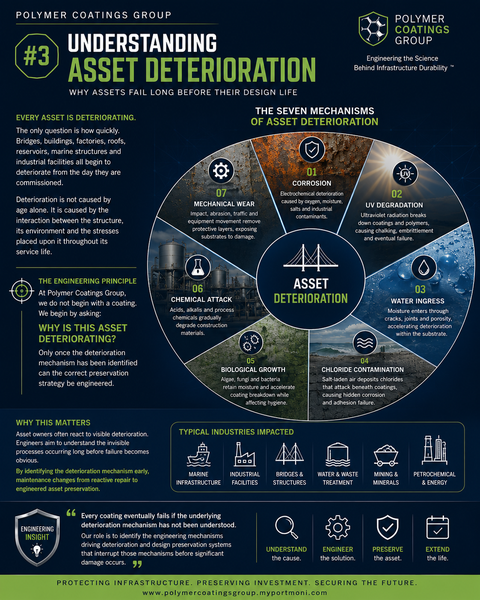
Corrosion
The electrochemical deterioration of metals caused by oxygen, moisture, salts and industrial contaminants.
Typical industries:
• Marine Infrastructure
• Ports
• Mining
• Water Treatment
• Petrochemical Facilities
• Bridges
• Structural Steel
UV Degradation
Continuous ultraviolet radiation slowly destroys many conventional coatings and polymeric materials, causing chalking, embrittlement, colour fading and eventual coating failure.
Particularly severe in:
• Southern Africa
• Namibia
• Coastal Regions
• High Solar Exposure Areas
Water Ingress
Water is often the transport mechanism that allows deterioration to accelerate.
Moisture enters through:
• Failed joints
• Cracked substrates
• Porous concrete
• Damaged waterproofing
• Failed roof systems
Once moisture reaches the substrate, deterioration progresses rapidly.
Chloride Contamination
One of the most aggressive deterioration mechanisms affecting coastal infrastructure.
Salt-laden air deposits microscopic chlorides onto exposed surfaces.
Even where corrosion is not immediately visible, chlorides continue attacking beneath coatings until adhesion eventually fails.
This is one of the primary reasons why infrastructure along Namibia's Atlantic coastline requires specialised preservation strategies.
Biological Growth
Algae, fungi, mould and bacterial colonies retain moisture against surfaces.
These biological contaminants accelerate coating deterioration while creating hygiene, aesthetic and maintenance problems.
In humid or coastal environments, biological growth should be considered an engineering concern rather than simply a cleaning issue.
Chemical Attack
Industrial chemicals, acids, alkalis and process contaminants gradually degrade many construction materials.
Correct material selection is therefore an engineering decision rather than a maintenance decision.
Mechanical Wear
Impact.
Abrasion.
Traffic.
Wind-blown sand.
Equipment movement.
Repeated mechanical loading steadily removes protective barriers until substrates become exposed.
Protection systems must therefore be selected according to expected mechanical loading.
Why This Matters
Asset owners often react to visible deterioration.
Engineers aim to understand the invisible processes occurring long before failure becomes obvious.
By identifying the deterioration mechanism early, maintenance changes from reactive repair to engineered asset preservation.
Polymer Coatings Group Engineering Insight
"Every coating eventually fails if the underlying deterioration mechanism has not been understood"
Our role is not simply to supply protective coatings.
Our role is to identify the engineering mechanisms driving deterioration and design preservation systems that interrupt those mechanisms before significant damage occurs.
Because protecting infrastructure begins with understanding why it deteriorates.
THE SEVEN MECHANISMS OF ASSET DETERIORATION
ASSET DETERIORATION
Corrosion
▲
UV ◄──────────────► Water Ingress
Biological Growth Chlorides
Chemical Attack Mechanical Wear


