THE POLYMER COATINGS GROUP METHODOLOGY
📘 PCG Engineering Resource Centre
Engineering Resource #2
THE POLYMER COATINGS GROUP METHODOLOGY
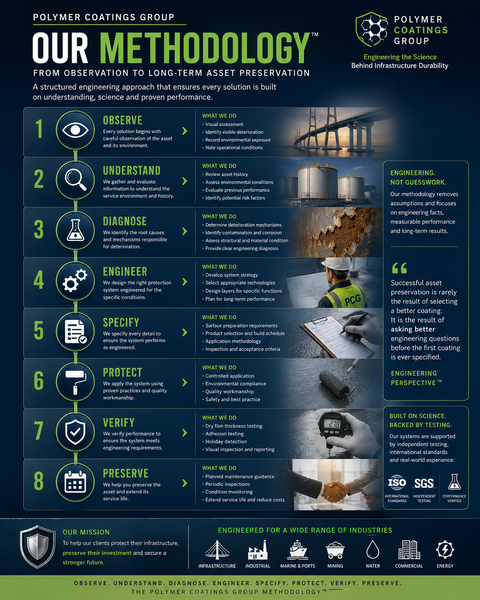
From Observation to Long-Term Asset Preservation
At Polymer Coatings Group, we believe that successful asset preservation does not begin with selecting a coating.
It begins with understanding the asset.
Every structure, regardless of its age or function, tells a story through its visible condition. Corrosion staining, coating dis-colouration, cracking, water ingress, biological growth and surface deterioration are rarely the problem themselves. They are indicators of underlying deterioration mechanisms that require engineering evaluation.
For this reason, every preservation strategy we recommend follows a structured engineering methodology developed to identify the cause before specifying the solution.
Our objective is not simply to repair deterioration.
Our objective is to understand it, engineer the appropriate preservation system and extend the service life of the asset.
STEP 1
OBSERVE
Every engineering solution begins with careful observation.
Visible deterioration provides valuable information regarding the condition of the asset and the environmental forces acting upon it.
Typical observations include:
• Corrosion staining
• Water ingress
• Coating failure
• Biological contamination
• Surface cracking
• Concrete deterioration
• Chemical attack
• UV degradation
Observation is not diagnosis.
It is the beginning of understanding.
STEP 2
INVESTIGATE
Visible symptoms seldom reveal the complete engineering problem.
During this stage we evaluate the operating environment, previous maintenance history, substrate condition and the likely mechanisms responsible for deterioration.
This process may include:
• Environmental exposure assessment
• Coastal contamination
• Moisture evaluation
• Surface preparation assessment
• Previous coating performance
• Structural condition
Only after understanding the service environment can an appropriate preservation strategy be developed.
STEP 3
DIAGNOSE
Engineering decisions should be based on causes rather than symptoms.
At this stage we identify the primary deterioration mechanisms affecting the asset.
These may include:
• Atmospheric corrosion
• Chloride contamination
• Carbonation
• Water ingress
• Ultraviolet degradation
• Chemical exposure
• Thermal cycling
• Mechanical wear
Accurate diagnosis reduces unnecessary repairs and improves long-term performance.
STEP 4
ENGINEER
Every preservation project requires an engineered solution specific to the operating environment.
Rather than selecting individual products, we develop complete protection systems designed around:
• Service environment
• Design life expectations
• Chemical exposure
• Abrasion requirements
• Waterproofing requirements
• Corrosion protection
• Maintenance philosophy
Every layer within the system performs a defined engineering function.
STEP 5
SPECIFY
Successful performance depends upon far more than the coating itself.
System specifications include:
• Surface preparation
• Primer selection
• Intermediate barrier layers
• Topcoat technology
• Dry film thickness
• Application methodology
• Curing requirements
• Inspection criteria
Clear specifications reduce application risk and improve long-term durability.
STEP 6
APPLY
Engineering performance depends upon correct installation.
Application should always follow recognized industry best practice together with the specified environmental conditions and quality requirements.
Quality workmanship transforms engineering design into engineering performance.
STEP 7
VERIFY
Performance should never rely upon assumptions.
Completed systems should be inspected to confirm compliance with specification requirements.
Verification may include:
• Dry film thickness measurements
• Adhesion testing
• Holiday detection
• Visual inspection
• Cure verification
Inspection protects both the asset owner and the engineering specification.
STEP 8
PRESERVE
Asset preservation does not end when the coating cures.
Infrastructure should be monitored throughout its operational life to ensure that maintenance occurs before deterioration progresses into structural failure.
Planned preservation significantly extends service life, reduces life-cycle costs and protects long-term capital investment.
Our engineering process : ↩
Observe
│
▼
Investigate
│
▼
Diagnose
│
▼
Engineer
│
▼
Specify
│
▼
Apply
│
▼
Verify
│
▼
Preserve
Why This Methodology Matters
Many coating failures are incorrectly attributed to product performance.
In reality, premature failure often results from one or more of the following:
• Incorrect diagnosis
• Inadequate surface preparation
• Unsuitable system selection
• Poor application practices
• Lack of inspection
• Absence of long-term maintenance planning
Our methodology is designed to address each of these factors systematically, ensuring that preservation decisions are based on engineering principles rather than assumptions.
Engineering Perspective :
"Successful asset preservation is rarely the result of selecting a better coating.
It is the result of asking better engineering questions before the first coating is ever specified."


