SURFACE ENGINEERING
📘 PCG Engineering Resource Centre
Engineering Resource #8
SURFACE ENGINEERING
The Most Important Step Nobody Sees
"The performance of any protective coating system is determined long before the first coat is applied."
Introduction
When a protective coating fails prematurely, the coating itself is often blamed. In reality, the root cause is frequently found elsewhere.
Surface contamination, inadequate preparation, residual moisture, incorrect surface profile or poor substrate assessment can significantly reduce coating performance regardless of the quality of the coating selected.
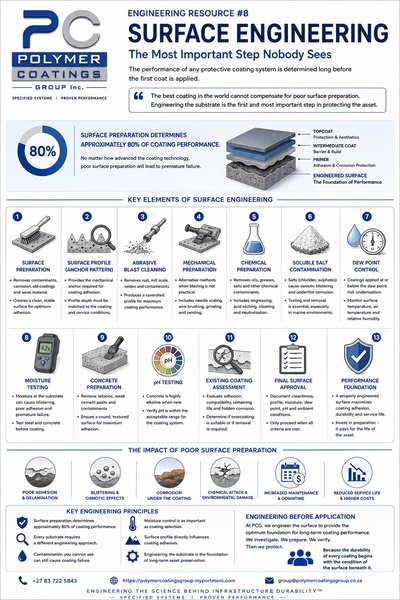
Industry experience consistently demonstrates that surface preparation is the single most influential factor affecting the long-term performance of protective coating systems. It is widely accepted within the protective coatings industry that approximately 80% of a coating system's performance is determined by the condition and preparation of the substrate before application.
Successful asset preservation therefore begins with engineering the surface—not simply selecting the coating.
What is Surface Engineering?
Surface Engineering is the systematic process of evaluating, preparing and conditioning a substrate to ensure optimum adhesion, durability and long-term performance of a protective coating system.
Rather than viewing preparation as a preliminary task, Surface Engineering treats the substrate as an integral component of the overall protection system.
Every substrate presents unique engineering challenges. Steel, concrete, galvanized surfaces, fibre cement, aluminium and previously coated structures each require different preparation methodologies to achieve reliable long-term performance.
Why Surface Preparation Matters
A protective coating can only perform as well as the surface to which it is applied.
Regardless of coating technology, inadequate preparation increases the likelihood of:
- Premature coating failure
- Reduced adhesion
- Osmotic blistering
- Corrosion beneath the coating
- Delamination
- Chemical attack
- Moisture-related failures
- Increased maintenance costs
- Reduced service life
The engineering objective is to establish a clean, stable and suitably profiled substrate capable of supporting the specified protection system throughout its intended design life.
Engineering Considerations Before Application
Surface Condition Assessment
Every successful project begins with understanding the condition of the existing substrate.
An engineering assessment typically evaluates:
- Existing deterioration
- Corrosion severity
- Concrete condition
- Existing coating integrity
- Previous repair history
- Environmental exposure
- Structural defects
- Moisture-related risks
Without a thorough assessment, selecting the correct protection system becomes largely speculative.
Surface Contamination
Many contaminants are invisible to the naked eye.
These include:
- Soluble salts
- Oil
- Grease
- Chlorides
- Sulphates
- Industrial pollutants
- Biological contamination
If these contaminants remain on the substrate, they can compromise adhesion and promote premature coating failure.
Engineering investigation should always determine contamination levels before specifying the preparation methodology.
Soluble Salt Contamination
One of the most overlooked causes of coating failure is soluble salt contamination.
Even after visible corrosion has been removed, chlorides and sulphates may remain embedded within the steel surface.
When encapsulated beneath a coating, these salts attract moisture through osmotic action, often leading to blistering, under-film corrosion and premature coating breakdown.
Testing and removal of soluble salts should therefore form an essential part of surface preparation in marine, coastal and industrial environments.
Surface Profile (Anchor Pattern)
Protective coatings require both chemical adhesion and mechanical anchorage.
Blast cleaning creates a microscopic surface profile—or anchor pattern—that allows coatings to lock mechanically onto the substrate.
An insufficient profile reduces adhesion.
An excessive profile may create coating voids and inadequate film thickness over profile peaks.
Surface profile should therefore be matched to both the coating specification and the intended service environment.
Abrasive Blast Cleaning
Where practical, abrasive blast cleaning remains one of the most effective methods of preparing steel substrates.
Proper blast cleaning removes:
- Mill scale
- Rust
- Existing coating residues
- Surface contamination
- Oxidation products
It also produces the controlled anchor profile required for high-performance protective coating systems.
Mechanical Surface Preparation
Where abrasive blasting is impractical, mechanical preparation may be appropriate.
Typical methods include:
- Needle scaling
- Rotary wire brushing
- Power sanding
- Grinding
- Mechanical abrasion
The selected method should achieve the cleanliness standard required by the coating specification.
Chemical Surface Preparation
Certain contaminants cannot be removed effectively through mechanical cleaning alone.
Chemical preparation may involve:
- Degreasing
- Soluble salt removal
- Alkaline cleaning
- Acid etching where appropriate
- Neutralization
- Surface conditioning
Chemical preparation should always be compatible with both the substrate and the specified coating system.
Moisture Testing
Moisture is one of the leading contributors to coating failure.
Prior to coating application, substrates should be evaluated for:
- Free moisture
- Entrapped moisture
- Moisture migration
- Relative humidity
- Concrete moisture content
Applying coatings over damp substrates significantly increases the risk of blistering, adhesion failure and osmotic activity.
Dew Point Monitoring
Condensation may be invisible but can have serious consequences for coating performance.
Engineering practice requires monitoring:
- Air temperature
- Surface temperature
- Relative humidity
- Dew point
Coatings applied at or below the dew point may suffer immediate adhesion problems despite appearing satisfactory during application.
Concrete Surface Preparation
Concrete presents different engineering challenges from steel.
Assessment should consider:
- Surface laitance
- Porosity
- Moisture content
- Cracking
- Surface contaminants
- Surface strength
- Previous repairs
Proper preparation ensures coatings bond to sound concrete rather than weak surface layers.
pH Testing
Fresh concrete remains highly alkaline.
Surface pH should be verified before applying many protective coating systems.
Failure to confirm acceptable pH levels may result in adhesion problems or premature coating degradation.
Existing Coating Assessment
Before overcoating an existing system, engineers should determine:
- Existing coating type
- Remaining adhesion
- Compatibility with new coatings
- Extent of deterioration
- Hidden corrosion
- Required repair methodology
Not every existing coating should be overcoated.
Sometimes complete removal provides the only reliable long-term solution.
Engineering Before Application
Protective coatings should never be specified solely on product performance data.
Successful asset preservation requires engineering decisions based upon:
- Substrate condition
- Environmental exposure
- Surface cleanliness
- Surface profile
- Moisture condition
- Coating compatibility
- Expected service life
The coating system forms only one component of the overall engineering solution.
The PCG Engineering Approach
At Polymer Coatings Group, we believe surface preparation is not a preliminary activity—it is an engineering discipline.
Our methodology begins with understanding the substrate, identifying deterioration mechanisms and preparing the surface to provide the optimum foundation for long-term coating performance.
Only once the substrate has been correctly engineered do we specify the most appropriate protective coating system.
Because the durability of every coating begins with the condition of the surface beneath it.
Key Engineering Principles
✔ Surface preparation determines approximately 80% of coating performance.
✔ Every substrate requires a different engineering approach.
✔ Contamination you cannot see can still cause coating failure.
✔ Moisture control is as important as coating selection.
✔ Surface profile directly influences coating adhesion.
✔ Engineering the substrate is the foundation of long-term asset preservation.
"The best coating in the world cannot compensate for poor surface preparation. Engineering the substrate is the first and most important step in protecting the asset."


