ROOT CAUSE FAILURE ANALYSIS (RCFA)
📘 PCG Engineering Resource Centre
Engineering Resource #7
ROOT CAUSE FAILURE ANALYSIS (RCFA)
Engineering Better Decisions Through Failure Investigation
Infrastructure assets rarely fail without warning.
Corrosion, coating breakdown, concrete deterioration and structural degradation are not failures in themselves—they are visible symptoms of underlying deterioration mechanisms. Yet, many maintenance programmes focus on repairing the visible damage without first understanding the engineering factors responsible for the failure.
The consequence is predictable. The asset may appear restored, but the original cause remains unchanged. Months or years later, the same defects reappear, often with greater severity and at significantly higher cost.
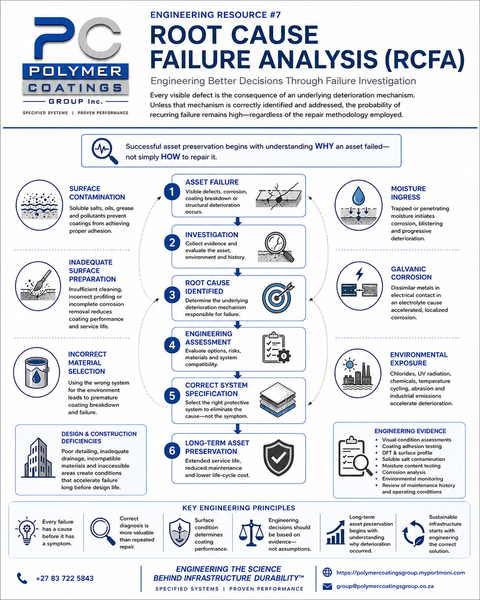
At Polymer Coatings Group (PCG), we believe successful asset preservation begins with understanding why an asset failed—not simply how to repair it.
Every engineering solution should be based on evidence, not assumptions.
Understanding Root Cause Failure Analysis
Root Cause Failure Analysis (RCFA) is a systematic engineering process used to identify the fundamental factors responsible for asset deterioration. Rather than treating corrosion, delamination or structural damage as isolated events, RCFA investigates the environmental, mechanical, chemical and operational conditions that initiated the failure.
Every visible defect is the consequence of an underlying deterioration mechanism. Unless that mechanism is correctly identified and addressed, the probability of recurring failure remains high, regardless of the repair methodology employed.
By identifying these root causes, engineers can specify protection systems that address the actual problem instead of merely concealing its symptoms.
Why Engineering Investigation Matters
Successful repairs are rarely achieved through product selection alone.
- The long-term performance of any protective system depends on understanding the interaction between:
- The asset and its construction materials
- The operating environment
- The deterioration mechanism
- Previous maintenance history
- Surface condition
- The suitability of the proposed protection system
Without this understanding, even the highest-performance coating technology may fail prematurely.
Engineering begins with investigation—not specification.
Common Causes of Premature Asset Failure
Although every project presents unique challenges, most infrastructure failures can be traced to one or more underlying engineering factors.
Surface Contamination
Invisible contaminants such as soluble salts, oils, grease and industrial pollutants can prevent protective coatings from achieving proper adhesion. Even premium coating systems may fail prematurely if contaminants remain on the substrate.
Inadequate Surface Preparation
Protective coating systems perform only as well as the substrate to which they are applied. Insufficient cleaning, incorrect surface profiling or incomplete removal of corrosion significantly reduces coating performance and service life.
Incorrect Material Selection
Every operating environment presents different exposure conditions. A coating system designed for atmospheric exposure may perform poorly in marine environments, immersion service, chemical processing facilities or areas subjected to severe ultraviolet radiation.
Material selection should always be based on engineering requirements rather than familiarity or cost alone.
Moisture Ingress
Water remains one of the most destructive agents affecting infrastructure. Moisture trapped beneath coatings or penetrating porous substrates promotes corrosion, blistering, osmotic pressure and progressive deterioration.
Unless the source of moisture is identified and controlled, deterioration is likely to continue.
Galvanic Corrosion
When dissimilar metals are placed in electrical contact in the presence of an electrolyte, accelerated corrosion may occur. Unless this electrochemical process is recognized during design or maintenance, localized deterioration can progress rapidly.
Environmental Exposure
Marine chlorides, industrial emissions, ultraviolet radiation, temperature cycling, abrasion, erosion and chemical exposure all contribute to accelerated asset deterioration.
Understanding the operating environment is fundamental to selecting an appropriate protection strategy.
Design and Construction Deficiencies
Poor detailing, inadequate drainage, water traps, inaccessible maintenance areas and incompatible material combinations frequently create conditions that accelerate deterioration long before the asset reaches its intended design life.
Many failures originate in design rather than maintenance.
Engineering Evidence
A Root Cause Failure Analysis should be supported by objective evidence rather than assumptions.
Depending on the asset and operating environment, engineering investigations may include:
- Visual condition assessments
- Coating adhesion testing
- Dry Film Thickness (DFT) measurements
- Soluble salt contamination testing
- Surface profile measurements
- Moisture content testing
- Environmental condition monitoring
- Corrosion product identification
- Microscopic examination where appropriate
- Review of maintenance history and operating conditions
The objective is not simply to identify what failed, but to understand why it failed.
Treat the Cause—Not the Symptom
Applying a new coating over an existing failure without understanding the underlying deterioration mechanism rarely delivers a long-term solution.
For example:
- Repainting over active corrosion does not stop corrosion.
- Waterproofing damp concrete does not eliminate moisture migration.
- Repairing cracks without understanding structural movement often results in recurring failures.
- Replacing deteriorated components without correcting the operating environment simply restarts the deterioration cycle.
Effective engineering solutions eliminate the cause—not merely improve the appearance.
The PCG Engineering Approach
Our engineering methodology is founded on investigation before specification.
Every project begins by evaluating the condition of the asset, identifying deterioration mechanisms and assessing the operating environment before recommending an engineering solution.
This process may include:
- Asset condition assessments
- Surface contamination evaluation
- Environmental exposure analysis
- Corrosion mechanism identification
- Substrate compatibility assessment
- Protective system selection
- Life-cycle performance evaluation
- Maintenance strategy recommendations
By understanding the interaction between the asset, its environment and the selected protection system, long-term durability can be significantly improved while reducing maintenance frequency and total life-cycle costs.
Engineering Before Products
Protective coatings should never be selected simply because they are familiar or readily available.
Every specification should be based on engineering principles supported by scientific understanding of deterioration mechanisms, environmental exposure, material compatibility and expected service conditions.
At Polymer Coatings Group, our objective is not simply to supply protective coating systems.
Our objective is to engineer practical, evidence-based asset preservation solutions that extend infrastructure service life, reduce maintenance costs and improve long-term asset reliability.
Key Engineering Principles
✔ Every failure has a cause before it has a symptom.
✔ Correct diagnosis is more valuable than repeated repair.
✔ Surface condition determines coating performance.
✔ Engineering decisions should be based on evidence—not assumptions.
✔ Long-term asset preservation begins with understanding why deterioration occurred.
✔ Sustainable infrastructure starts with engineering the correct solution—not simply selecting the next coating.


