LIFECYCLE ENGINEERING
📘 PCG Engineering Resource Centre
Engineering Resource #9
LIFECYCLE ENGINEERING
Engineering Infrastructure for Maximum Service Life
"The true cost of infrastructure is not its construction—it is the cost of owning, maintaining and preserving it throughout its service life."
Introduction
Every infrastructure asset is designed with an expected service life.
Whether it is a bridge, water treatment plant, port structure, storage tank, industrial facility or commercial building, its long-term performance depends not only on its original design, but on the engineering decisions made throughout its operational life.
Unfortunately, many maintenance programmes remain reactive.
Repairs are often initiated only after visible deterioration has occurred, by which time damage has accelerated, repair costs have increased and service interruptions may already be affecting operations.
Lifecycle Engineering takes a different approach.
Rather than responding to failure, it focuses on preserving infrastructure through planned engineering interventions that maximize asset performance, minimize life-cycle costs and extend operational service life.
What is Lifecycle Engineering?
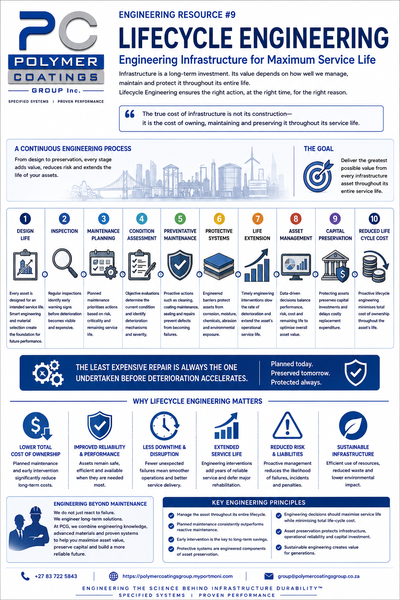
Lifecycle Engineering is the systematic management of an asset from its initial construction through operation, maintenance, rehabilitation and eventual replacement.
It combines engineering, maintenance planning, condition monitoring and asset management into a single long-term strategy.
The objective is simple:
Deliver the greatest possible value from every infrastructure asset throughout its entire service life.
Engineering the Entire Asset Lifecycle
Successful infrastructure management is not a single event.
It is a continuous engineering process.
Design Life
Every asset is designed for an intended operational lifespan.
Engineering decisions made during design—including material selection, environmental exposure and protective systems—establish the foundation for future performance.
However, design life should never be viewed as guaranteed.
Without appropriate maintenance, even well-designed infrastructure can deteriorate long before reaching its intended service life.
Inspection
Infrastructure should be inspected long before deterioration becomes visually obvious.
Routine inspections allow engineers to identify early warning signs including:
- Protective coating degradation
- Corrosion initiation
- Concrete cracking
- Water ingress
- Structural movement
- Mechanical wear
- Environmental damage
Early detection allows corrective action before minor defects develop into major failures.
Maintenance Planning
Effective maintenance is planned—not reactive.
Maintenance planning prioritises engineering interventions according to asset condition, operational risk and remaining service life.
This approach reduces emergency repairs, minimizes operational disruption and improves maintenance budgeting.
Planned maintenance almost always costs less than emergency repair.
Condition Assessment
Engineering decisions should always be supported by objective evidence.
Condition assessments evaluate:
- Structural integrity
- Corrosion severity
- Remaining coating performance
- Moisture-related deterioration
- Environmental exposure
- Mechanical damage
- Previous maintenance history
Understanding the condition of an asset allows maintenance resources to be directed where they deliver the greatest benefit.
Preventative Maintenance
Preventative maintenance focuses on preserving assets before deterioration becomes critical.
Examples include:
- Protective coating maintenance
- Joint sealing
- Corrosion control
- Waterproofing
- Concrete repair
- Structural inspections
- Cleaning programmes
- Environmental protection measures
Preventative maintenance reduces both operational risk and long-term expenditure.
Protective Systems
Protective systems should not be viewed as cosmetic finishes.
They are engineered barriers that reduce deterioration caused by:
- Corrosion
- Moisture ingress
- Chemical attack
- Abrasion
- Ultraviolet radiation
- Thermal cycling
- Industrial pollutants
Properly specified protection systems preserve the structural integrity of the underlying asset while extending maintenance intervals.
Life Extension
Every successful engineering intervention increases the remaining service life of an asset.
The objective is not merely to repair damage but to delay major rehabilitation or replacement by slowing the rate of deterioration.
Extending infrastructure service life delivers significant operational and financial benefits.
Asset Management
Modern infrastructure management integrates engineering with financial planning.
Asset managers continually balance:
- Asset condition
- Operational performance
- Maintenance expenditure
- Risk exposure
- Remaining service life
- Capital investment
Engineering information supports informed decisions regarding maintenance, rehabilitation and future capital planning.
Capital Preservation
Infrastructure represents one of the largest investments made by governments, municipalities and industry.
Protecting these assets is therefore not simply a maintenance activity.
It is capital preservation.
Every year that an asset remains in reliable operation postpones replacement expenditure and improves return on investment.
Well-maintained infrastructure protects both public resources and shareholder value.
Reducing Life-Cycle Costs
The initial construction cost represents only a fraction of an asset's total cost of ownership.
Long-term expenditure includes:
- Inspection
- Maintenance
- Repairs
- Downtime
- Rehabilitation
- Replacement
- Operational disruption
Lifecycle Engineering seeks to minimize these cumulative costs through proactive engineering decisions rather than reactive maintenance.
The least expensive repair is often the one undertaken before deterioration accelerates.
The PCG Engineering Philosophy
At Polymer Coatings Group, we believe infrastructure should never be managed one repair at a time.
Every engineering recommendation should contribute to a broader lifecycle strategy that improves reliability, extends service life and protects long-term capital investment.
Protective systems are not the objective.
Reliable infrastructure is.
Our role is to engineer practical asset preservation solutions that support owners in achieving maximum value from every infrastructure investment.
Looking Beyond Maintenance
Engineering is no longer measured by the ability to repair assets.
It is measured by the ability to preserve them.
Successful organisations no longer ask:
"How do we repair this?"
They ask:
"How do we prevent this from failing in the first place?"
That question defines the future of modern infrastructure management.
Key Engineering Principles
✔ Infrastructure should be managed throughout its entire lifecycle—not only when failures occur.
✔ Planned maintenance consistently outperforms reactive maintenance.
✔ Early intervention significantly reduces long-term costs.
✔ Protective systems are engineered components of asset preservation—not cosmetic finishes.
✔ Engineering decisions should maximize service life while minimizing total life-cycle cost.
✔ Asset preservation protects infrastructure, operational reliability and capital investment.


