Engineer's Reference Page.
📘 PCG Engineering Resource Centre
Engineering Resource #5
ENGINEERING STANDARDS
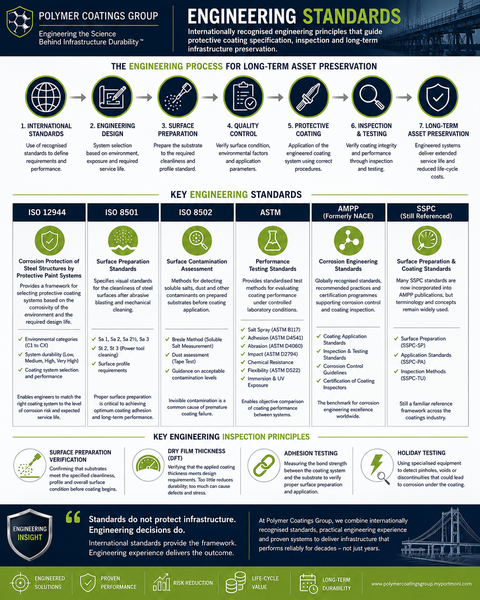
Internationally recognized engineering principles that guide protective coating specification, inspection and long-term infrastructure preservation.
Engineering Decisions Should Never Be Based on Product Claims Alone.
At Polymer Coatings Group, every protective system is developed around internationally recognized engineering principles, recognized testing methodologies and accepted industry practices.
Engineering standards provide a common technical language between asset owners, consulting engineers, project managers, contractors and coating manufacturers.
They help ensure that protective systems are selected, applied and inspected according to measurable performance criteria rather than assumptions.
While every project presents unique environmental and operational challenges, the engineering principles behind long-term asset preservation remain consistent.
The standards below represent many of the internationally recognized references used throughout the corrosion protection and infrastructure preservation industry.
International Engineering Standards
ISO 12944
Corrosion Protection of Steel Structures by Protective Paint Systems
Perhaps the world's most widely recognized corrosion protection standard.
ISO 12944 provides guidance for selecting protective coating systems based on environmental exposure conditions and expected service life.
The standard classifies environments ranging from low-corrosivity indoor conditions through highly aggressive marine and offshore environments.
Rather than selecting coatings solely by product type, engineers use ISO 12944 to match protective systems to the anticipated corrosion risk throughout the asset's design life.
ISO 8501
Surface Preparation Standards
A protective coating can only perform as well as the surface beneath it.
ISO 8501 establishes internationally recognized visual standards for steel surface preparation following abrasive blasting and mechanical cleaning.
Surface cleanliness directly influences coating adhesion, long-term corrosion resistance and service life.
ISO 8502
Surface Contamination Assessment
Even perfectly blasted steel may still contain invisible contaminants.
ISO 8502 provides methods for detecting soluble salts, dust and other contaminants remaining on prepared substrates before coating application.
These invisible contaminants are often responsible for premature coating failure if not properly removed.
ASTM International
Performance Testing Standards
ASTM standards provide internationally recognized laboratory procedures for evaluating coating performance.
Typical testing includes:
• Salt spray resistance
• Adhesion strength
• Abrasion resistance
• Flexibility
• Impact resistance
• Chemical resistance
• Water immersion
• UV weathering
These standardized test methods allow engineers to compare coating performance under controlled conditions.
AMPP International
(Formerly NACE International)
Corrosion Engineering Standards
AMPP is recognized globally as one of the leading authorities in corrosion engineering, coating inspection and asset integrity.
Its standards, technical publications and inspector certification programmes have become the benchmark across industries including:
• Oil & Gas
• Mining
• Marine
• Petrochemical
• Infrastructure
• Water Treatment
• Power Generation
AMPP guidance supports engineers in specifying protective systems capable of delivering predictable long-term performance.
SSPC Standards
Although many SSPC standards have now been incorporated into AMPP publications, engineers continue to reference SSPC terminology throughout specifications and project documentation.
These standards remain familiar throughout much of the international coatings industry.
Engineering Inspection Principles
Successful asset preservation depends not only on selecting the correct coating system, but also on verifying that every stage of application meets engineering requirements.
Typical inspection activities include:
Surface Preparation Verification
Confirming that substrates meet the specified cleanliness profile before coating begins.
Dry Film Thickness (DFT)
Verifying that the applied coating thickness meets design requirements.
Too little coating reduces durability.
Excessive thickness may introduce unnecessary stresses or application defects.
Adhesion Testing
Measuring the bond strength between the coating system and the substrate to verify proper surface preparation and application.
Holiday Detection
Using specialized equipment to identify microscopic discontinuities or pinholes within protective coatings before assets are placed into service.
Engineering Beyond Compliance
Standards establish minimum engineering requirements.
Long-term asset preservation often requires looking beyond minimum compliance to understand the interaction between environmental exposure, substrate condition, protective system design and future maintenance planning.
At Polymer Coatings Group, we believe engineering judgement, practical field experience and internationally recognized standards should work together to deliver infrastructure that performs reliably for decades rather than years.
Engineering Insight
Standards do not protect infrastructure. Engineering decisions do.
International standards provide the framework for selecting, testing and evaluating protective systems, but successful asset preservation ultimately depends on correctly interpreting those standards in the context of each individual project.
That is where engineering experience becomes as valuable as the standards themselves.


