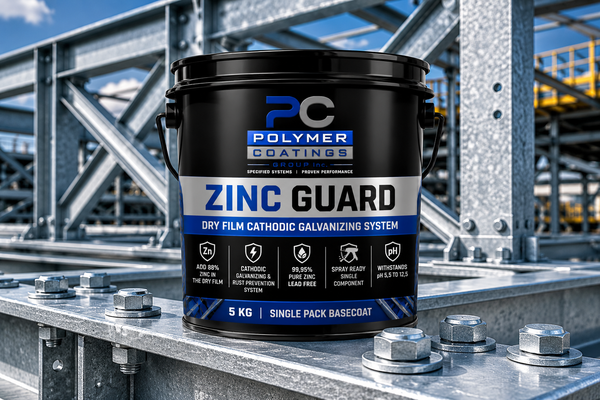



Zinc Guard Active Cathodic Zinc-Rich Primer
Zinc Guard
Active Cathodic Zinc-Rich Primer
Engineered Galvanic Corrosion Protection for Long-Term Steel Asset Preservation
Engineering Overview
Corrosion begins the moment unprotected steel is exposed to moisture, oxygen and aggressive electrolytes. While conventional anti-corrosive primers rely primarily on barrier protection, mechanical damage, abrasion and weathering inevitably create pathways for corrosion to initiate during the service life of a structure.
Zinc Guard is a high-performance, two-component zinc-rich cathodic primer engineered to provide active galvanic corrosion protection for carbon steel operating in aggressive industrial, marine and coastal environments.
Unlike conventional primers that simply isolate steel from the environment, Zinc Guard incorporates a high concentration of electrically conductive metallic zinc particles that sacrifice themselves before the steel substrate begins to corrode. This electrochemical protection mechanism significantly delays corrosion initiation, even where localized coating damage or discontinuities occur.
As the foundation layer of the Polymer Coatings Group Duplex Cathodic Protection System, Zinc Guard combines active galvanic protection with high-performance barrier coating technology to maximise coating durability and extend infrastructure service life.
The Engineering Challenge
Protective coating systems are subjected to continual mechanical damage throughout their operational life.
Transportation, handling, impact, abrasion, maintenance activities and general weathering eventually expose small areas of bare steel.
Conventional primers provide little protection once the coating barrier has been compromised, allowing corrosion to initiate rapidly at damaged locations.
For critical infrastructure operating in severe corrosive environments, long-term protection requires more than a barrier coating—it requires an active corrosion protection mechanism capable of protecting exposed steel after coating damage has occurred.
Engineering Solution
Zinc Guard has been engineered to provide active sacrificial cathodic protection through galvanic action.
The coating contains a high loading of electrically conductive metallic zinc particles that establish electrical continuity with the prepared steel substrate.
When exposed to moisture, the zinc functions as a sacrificial anode, preferentially corroding before the steel. This electrochemical reaction continues to protect exposed steel at scratches, coating defects and mechanical damage, significantly reducing corrosion initiation and under-film corrosion.
Unlike conventional anti-corrosive primers, Zinc Guard continues protecting the substrate even when the coating barrier has been locally compromised.
Independent Performance Verification
Zinc Guard has undergone independent laboratory testing to internationally recognized standards.
Performance Verification
- ISO 12944 – C5 High Durability
- ISO 12944 – CX / IM4 Severe Marine Exposure
- ASTM B117 – 4,200 Hours Neutral Salt Spray Resistance
- Testing Laboratory: SGS United Kingdom (ISO/IEC 17025 Accredited)
- Independent verification conducted in South Africa
These independent evaluations confirm the system's suitability for demanding industrial, marine and coastal service environments.
Active Corrosion Protection Mechanism
Unlike conventional barrier primers, Zinc Guard protects steel through electrochemical action.
The zinc particles within the coating establish electrical contact with the steel substrate.
When moisture creates an electrolyte, the zinc preferentially corrodes, sacrificing itself to protect the steel beneath.
This galvanic protection continues to function even where localized coating damage exposes the substrate, delaying corrosion until the available zinc has been consumed.
The result is a corrosion protection system that actively protects steel rather than simply covering it.
Engineering Performance
When incorporated into professionally designed corrosion protection systems, Zinc Guard provides:
- Active sacrificial cathodic corrosion protection
- Excellent adhesion to correctly prepared steel substrates
- Outstanding flexibility and impact resistance
- High electrical conductivity
- Excellent weldability with minimal influence on welded joints
- Excellent resistance to marine and industrial environments
- Outstanding saltwater resistance
- Ultraviolet weathering resistance
- Service temperature range from –40°C to +300°C
- Chemical resistance across a pH range of 5.5–12.5
- Suitable for use as a stand-alone zinc-rich primer or as the galvanic layer within engineered duplex coating systems
Recommended Film Thickness
Primer Application
- 80-125 μm Dry Film Thickness (DFT)
Typical Duplex Systems
- Total System Thickness up to approximately 375 - 600 μm DFT, depending on project specification.
Application Conditions
- Application Temperature: 10°C to 40°C
- Substrate Temperature: Minimum 3°C above dew point
- Relative Humidity: Below 80%
- Practical Coverage: Approximately 27.9 m² at 75 μm DFT
Typical Engineering Applications
Zinc Guard is recommended wherever long-term corrosion protection of carbon steel is required, including:
Marine & Coastal Infrastructure
- Ports and harbour facilities
- Marine terminals
- Ships and marine vessels
- Offshore support structures
- Coastal infrastructure
Industrial Facilities
- Petrochemical plants
- Oil & gas installations
- Refineries
- Chemical processing facilities
- Industrial manufacturing plants
Mining & Mineral Processing
- Structural steelwork
- Conveyors
- Processing plants
- Bulk material handling facilities
- Storage tanks and pipework
Infrastructure
- Bridges
- Water treatment facilities
- Wastewater treatment plants
- Power generation stations
- Commercial and municipal infrastructure
System Integration
Zinc Guard forms the galvanic foundation layer within the Polymer Coatings Group Duplex Cathodic Protection System.
When overcoated with Zinc Cathodic Extreme, the system combines two complementary corrosion protection mechanisms:
- Active galvanic protection through sacrificial zinc.
- Passive barrier protection against moisture, oxygen and aggressive chemicals.
Together these technologies provide significantly enhanced corrosion resistance, longer maintenance intervals and reduced whole-of-life asset costs compared with conventional coating systems.
Relationship Within the PCG Asset Preservation Engineering Methodology.
At Polymer Coatings Group, corrosion protection is approached as a complete engineering discipline rather than simply the application of protective coatings.
Successful long-term corrosion control depends upon:
- Environmental assessment
- Correct surface preparation
- Soluble salt removal where required
- Selection of the appropriate corrosion protection strategy
- Controlled coating application
- Dry film thickness verification
- Quality assurance and inspection
- Planned maintenance throughout the asset life cycle
Zinc Guard forms an integral component of this engineering methodology by providing active galvanic corrosion protection as the first line of defense against steel deterioration.
Engineering Support
Every structure operates under unique environmental and operational conditions.
Polymer Coatings Group provides technical support to consulting engineers, corrosion specialists, coating inspectors, contractors and infrastructure owners regarding:
- Corrosion risk assessment
- Coating system selection
- Surface preparation requirements
- Duplex coating system design
- Specification development
- Long-term asset preservation strategies
Our engineering team works closely with clients to develop corrosion protection systems tailored to specific operating environments and expected service lives.
Engineering Insight
Barrier coatings eventually fail. The question is what happens next?
Conventional primers protect steel only while the coating remains intact.
Once mechanical damage exposes bare steel, corrosion begins immediately.
Zinc-rich cathodic primers behave differently.
Rather than allowing corrosion to initiate at the damaged area, Zinc Guard sacrifices its own zinc content to protect the exposed steel through galvanic action.
This electrochemical protection mechanism is why zinc-rich primers remain the preferred foundation for many of the world's highest-performing corrosion protection systems operating in severe industrial, marine and coastal environments.
Important Information
Zinc Guard is intended for professional industrial corrosion protection applications.
Optimum performance depends upon correct surface preparation, environmental conditions, specified dry film thickness, application quality and appropriate overcoating intervals.
For maximum service life in highly aggressive environments, Zinc Guard should be specified as part of a complete engineered corrosion protection system in accordance with recognized industry standards and project-specific engineering requirements.


