Why do electrically Inert Coatings matter in modern corrosion engineering?
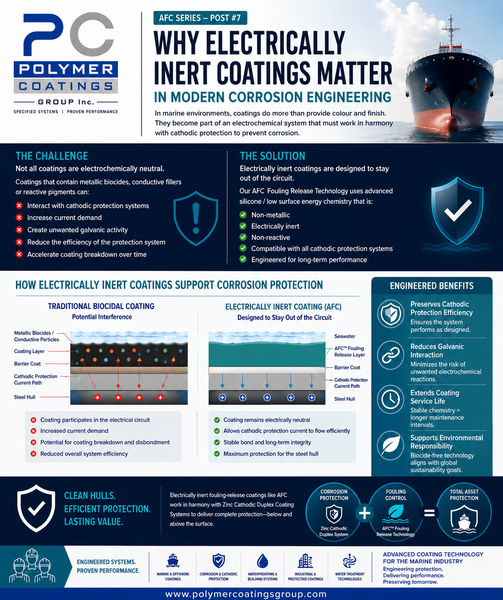
When decisions are made on the correct marine coatings for assets, there is one factor that corrosion engineers, ship owners, dry-docking specialists, and vessel designers increasingly evaluate - Electrical Conductivity⚡
Most Anti-fouling technologies have been designed to prevent marine growth. Traditional systems achieve this by incorporating metallic compounds/conductive additives into the coating matrix.
But how does the coating interact with the vessel's cathodic protection system?
Cathodic protection systems are engineered to control corrosion by directing electrical current in a predictable manner.
Whatever system you use, the system must protect the steel substrate by controlling electrochemical activity.
The effectiveness of these systems depends on maintaining carefully balanced electrical pathways across the protected structure.
If a coating contains conductive metallic particles/conductive pathways, engineers must consider how those materials interact with the vessel's corrosion protection strategy.
Considerations include:
Electrical continuity, Surface potential distribution, Current demand requirements, Long-term cathodic protection efficiency & Coating compatibility with corrosion management systems
Modern Fouling Release Technologies (FRT) and Advanced Fouling Control (AFC) systems take a different approach.
Instead of using metallic biocides to prevent marine growth, they utilize engineered surface chemistry to create ultra-low surface energy finishes.
The result is a coating that rather than poisoning marine organisms, the technology reduces their ability to establish a strong bond with the hull.
Why This Matters for Duplex Cathodic Protection Systems -
One of the reasons we became interested in German-formulated AFC technology is its potential compatibility with our advanced Zinc Cathodic Duplex Coating Systems.
Because the coating functions as a non-conductive fouling-release layer, it is designed to perform its fouling-control role without becoming part of the cathodic protection circuit itself.
Each technology performs its intended function without attempting to replace the other.
Looking Beyond Anti-Fouling -
The future of marine coatings is no longer just about preventing growth.
It is about integrating multiple technologies into a complete asset protection strategy.
That shift is driving growing interest in electrically inert fouling-release technologies worldwide.


