WHEN CONCRETE CRACKS ARE TREATED COSMETICALLY
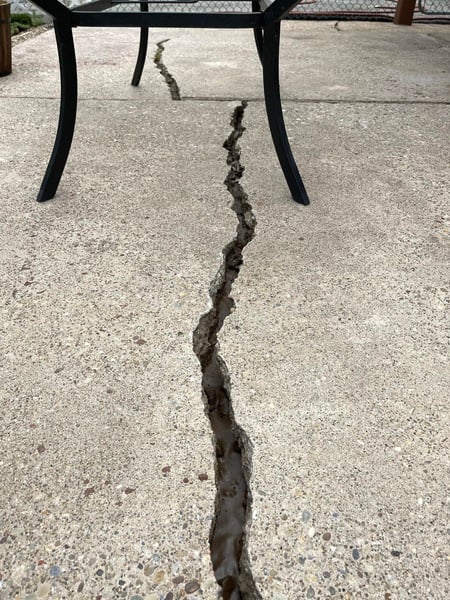
WHEN CONCRETE CRACKS ARE TREATED COSMETICALLY — THE STRUCTURAL PROBLEM STILL EXISTS
Across residential, commercial and hospitality environments throughout South Africa, we continue to see a growing trend where contractors attempt to “repair” failed cementitious substrates, by firstly cutting the crack-lines as new universal joints, then using high-load bearing tiles, standard tile adhesives and conventional grout systems — without properly investigating the underlying cause of the substrate failure itself.
While these types of repairs may initially appear acceptable visually, they often fail prematurely because the actual engineering problem beneath the surface was never addressed.
The reality is this:
A crack in a cementitious substrate is rarely the primary problem.
It is usually the visible symptom of a deeper failure mechanism occurring within the structure or substrate system.
WHAT MANY CONTRACTORS ARE CURRENTLY DOING WRONG
A common shortcut now entering the market involves:
• Installing the so-called high load-bearing( the load a tile can handle before snapping or cracking ) strength tiles directly over cracked slabs, after cutting the crack-lines open as new universal joints
• Using standard non-polymer modified tile adhesive systems
• Applying rigid grout systems over active cracks
• Ignoring slab movement behaviour
• Failing to assess substrate integrity
• Treating cracks cosmetically instead of structurally
This approach may temporarily hide visible cracking.
But it does not stop:
❌ Structural movement
❌ Ongoing substrate failure
❌ Differential settlement
❌ Moisture migration
❌ Thermal expansion stresses
❌ Flexural slab movement
❌ Weak substrate deterioration
❌ Shear transfer failure
❌ Delamination beneath finishes
In many cases, the crack simply reappears through the tile joints, grout lines or floor finish within months.
THE INDUSTRY PROBLEM:
“SURFACE REPAIRS” WITHOUT SUBSTRATE SCIENCE
One of the greatest concerns in the South African construction and maintenance sector is that many repairs today are performed only at surface level.
Very few contractors investigate:
• Why the slab failed
• Whether the substrate mix design was adequate
• If reinforcement integrity exists
• Whether water ingress has weakened the slab
• If there is underlying ground movement
• If the slab is suspended or raised
• Whether subsidence is occurring
• Whether expansion movement was accommodated correctly
• Whether the substrate has sufficient compressive and flexural strength remaining
Without understanding the root failure mechanism, the repair specification itself becomes compromised from the start.
CRACKED PATIO'S / VERANDAS - LODGES & HOSPITALITY STRUCTURES:
A GROWING RISK AREA
One environment where this is becoming increasingly problematic is within hospitality and lodge developments, especially in your more humid and sandy/bush environments.
Many raised concrete walkways, stepping platforms and suspended entertainment slabs are now showing:
• Full-surface cracking
• Structural movement
• Edge settlement
• Hollow substrate zones
• Surface separation
• Moisture-related deterioration
These failures are often caused by combinations of:
❌ Poor original concrete mix quality
❌ Inadequate reinforcement
❌ Weak subgrade support
❌ Ground movement
❌ Water ingress beneath slabs
❌ Erosion and wash-away conditions
❌ Thermal cycling
❌ Slope instability or landslide activity
In these situations, simply installing stronger tiles does absolutely nothing to solve the engineering issue occurring underneath the slab.
HIGH-STRENGTH TILES DO NOT CREATE A HIGH-STRENGTH SUBSTRATE
This is one of the biggest misconceptions in the industry.
A high-strength tile installed over a weak or unstable substrate does not strengthen the structure beneath it.
The performance of any flooring system will always depend on:
The integrity of the substrate itself.
If the substrate continues moving, flexing, cracking or deteriorating:
• The adhesive system fails
• Grout fractures
• Tiles de-bond
• Waterproofing systems rupture
• Moisture ingress accelerates
• Maintenance costs escalate
The finish layer is only as reliable as the substrate supporting it.
PROFESSIONAL REPAIR METHODOLOGY REQUIRES:
ENGINEERING-FIRST THINKING
At Polymer Coatings Group, our approach to cementitious repair systems is based around:
✔ Failure analysis
✔ Substrate science
✔ Structural behaviour understanding
✔ Movement accommodation
✔ Long-term lifecycle maintenance
✔ Engineered repair system compatibility
Our Poly-Vinex, Poly-Seal and Cementitious Repair Compound Systems are developed not merely as “repair products” — but as integrated substrate rehabilitation systems engineered for long-term performance.
This includes systems designed for:
• Crack injection and stabilization
• Flexible movement accommodation
• Polymer-modified repair mortars
• Structural repair bonding
• Surface reinstatement
• Waterproof rehabilitation
• High-build resurfacing systems
• Industrial substrate rehabilitation
• Civil infrastructure preservation
LONG-TERM ASSET PROTECTION REQUIRES MORE THAN PATCH REPAIRS
In today’s construction environment, infrastructure owners, engineers, consultants and facility managers should no longer evaluate repairs only on immediate cost or visual appearance.
The real question should be:
“Will this repair system still be protecting the asset 5–10 years from now?”
Because premature repair failure creates:
• Escalating maintenance cycles
• Asset deterioration
• Water ingress risk
• Liability exposure
• Operational disruption
• Increased lifecycle costs
Professional repair systems should therefore always be specified around:
✔ Root-cause analysis
✔ Structural assessment
✔ Environmental exposure conditions
✔ Substrate compatibility
✔ Flexural movement behaviour
✔ Long-term durability performance
THE INDUSTRY MUST SHIFT FROM:
“PATCHING CRACKS”
TO:
“UNDERSTANDING WHY STRUCTURES FAIL”
The future of infrastructure maintenance in South Africa will increasingly belong to companies, engineers and contractors who understand that true asset preservation begins beneath the surface.
Not with cosmetics.
But with engineering.
PC POLYMER COATINGS GROUP
SPECIFIED SYSTEMS | PROVEN PERFORMANCE


