Understanding Advanced Oxidation - Engineering Case Study 1
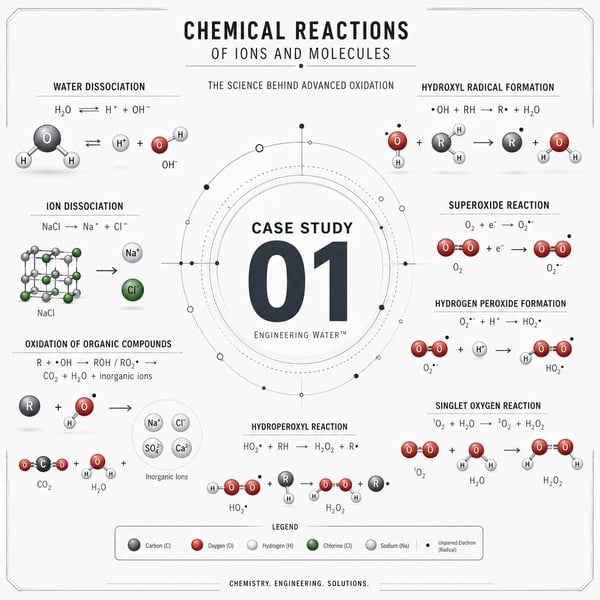
An Engineering Publication - Case Study by Polymer Coatings Group Inc.
" A continuation of our 'ENGINEERING WATER™' - Chapter 1 on Understanding Advanced Oxidation "
Publisher & Editor
- Polymer Coatings Group Inc. R&D
Co-Author
- Gerald van Rensburg
Infographic Design
- PCG Media
Applying Advanced Oxidation to Improve Water Quality
Lessons from Municipal Water Reuse Engineering
Background
As conventional water treatment technologies are increasingly challenged by complex organic contaminants, engineers have turned to Advanced Oxidation Processes (AOPs) to improve water quality beyond the capabilities of traditional treatment methods.
One well-documented engineering study evaluated the use of a UV/H₂O₂ Advanced Oxidation Process as part of a municipal water reuse treatment train following conventional treatment and microfiltration.
Rather than simply increasing disinfectant dosage, the objective was to understand how Advanced Oxidation could improve contaminant removal by generating highly reactive oxygen species capable of oxidizing compounds that are difficult to remove using conventional treatment alone.
Engineering Challenge
Conventional treatment processes successfully remove suspended solids, many microorganisms and a large proportion of dissolved contaminants.
However, some persistent organic compounds remain difficult to remove using conventional oxidation alone.
Engineers therefore investigated whether an Advanced Oxidation Process could further improve water quality by generating hydroxyl radicals capable of rapidly reacting with a broad range of organic contaminants.
Engineering Approach
The treatment train incorporated:
• Conventional treatment
↓
• Microfiltration
↓
• UV/H₂O₂ Advanced Oxidation
↓
• Final polishing
The objective was not to replace conventional treatment, but to complement it by introducing an additional oxidation stage where appropriate.
Engineering Outcome
The study demonstrated that the Advanced Oxidation Process significantly improved the degradation of many difficult-to-remove organic contaminants compared with conventional treatment alone.
The researchers also observed that treatment performance depended on several engineering variables, including:
- Water quality
- UV transmittance
- Hydrogen peroxide dosage
- Reactor operating conditions
- Contact time
These findings reinforce an important engineering principle:
Successful Advanced Oxidation depends as much on system design and operating conditions as it does on the oxidant itself.
Engineering Lessons Learned
This case study highlights several important engineering principles:
- Advanced Oxidation should be viewed as part of an integrated treatment system rather than a standalone solution.
- Understanding water quality characteristics before selecting an oxidation technology is essential.
- Treatment performance depends upon engineering design, operational control and water chemistry.
- Different oxidation technologies are appropriate for different treatment objectives.
- Effective water engineering begins by understanding the underlying treatment mechanisms before selecting the appropriate technology.
Why This Case Study Matters?
This case study demonstrates precisely why understanding oxidation is more important than simply selecting an oxidizing chemical.
Engineers who understand how Advanced Oxidation works, are better equipped to design treatment systems that improve water quality, optimize operating performance and support long-term sustainable water management.
Please take note , that we did not include removal percentages in the publication!!
Even though the published studies report impressive figures, they apply to the specific pilot systems and operating conditions that were tested.
With us focusing on the engineering principles rather than quoting performance numbers, we want to avoid implying that every Advanced Oxidation Process will achieve the same results under all conditions.
We prefer to keep this publication scientifically rigorous and aligned with the philosophy we've established throughout ENGINEERING WATER™:
Explain the engineering, not selling the technology.
Scientific References :
The engineering principles discussed in this publication are based upon internationally recognized scientific literature and established water treatment engineering practices relating to oxidation chemistry, Advanced Oxidation Processes (AOPs), Reactive Oxygen Species (ROS), municipal water treatment and environmental engineering.
Selected References
Glaze, W. H., Kang, J. W., & Chapin, D. H. (1987). The Chemistry of Water Treatment Processes Involving Ozone, Hydrogen Peroxide and Ultraviolet Radiation. Ozone: Science & Engineering, 9(4), 335–352.
Parsons, S. (Ed.). (2004). Advanced Oxidation Processes for Water and Wastewater Treatment. IWA Publishing, London.
von Gunten, U. (2003). Ozonation of Drinking Water: Part I. Oxidation Kinetics and Product Formation. Water Research, 37(7), 1443–1467.
Andreozzi, R., Caprio, V., Insola, A., & Marotta, R. (1999). Advanced Oxidation Processes (AOP) for Water Purification and Recovery. Catalysis Today, 53, 51–59.
Metcalf & Eddy. (2014). Wastewater Engineering: Treatment and Resource Recovery (5th ed.). McGraw-Hill Education.
American Water Works Association (AWWA). Water Quality & Treatment: A Handbook on Drinking Water (latest edition).
Engineering Notice
This publication has been prepared as an educational engineering resource.
The information presented explains the scientific principles governing oxidation and Advanced Oxidation Processes and is intended to promote a broader understanding of modern water treatment engineering. References are provided to acknowledge the foundational scientific literature upon which these engineering concepts are based.


