THE COST OF CORROSION SERIES™ | POST #4 ' Why Some Steel Keeps Protecting Itself '
THE COST OF CORROSION SERIES™ | POST #4
' Why Some Steel Keeps Protecting Itself '
If you've ever inspected an old steel structure, you may have noticed, that sometimes you'll find an area where the protective layer has been scratched or damaged, yet the surrounding steel shows remarkably little corrosion.
At first glance, it doesn't seem to make sense.
Shouldn't exposed steel start rusting immediately?
The answer lies in one of the most important principles in corrosion engineering ↩
Not all metals behave the same when they are electrically connected in the presence of moisture.
Some metals are naturally more willing to corrode than others.
Zinc is one of them.
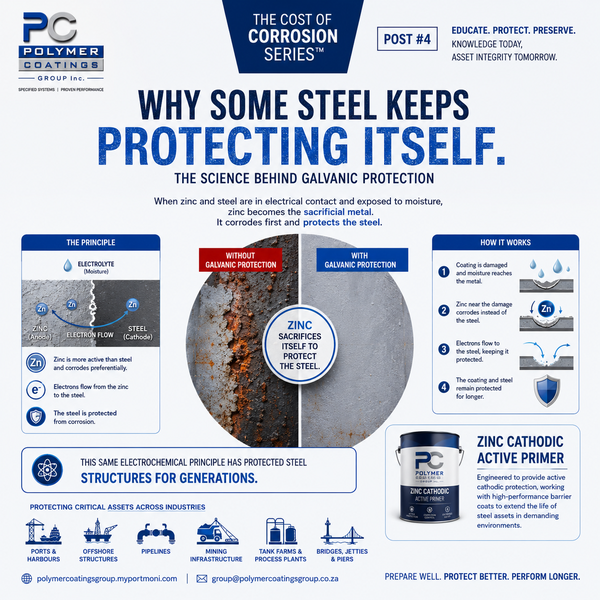
When zinc and steel are in electrical contact and exposed to an electrolyte such as rainwater, seawater or condensation, the zinc becomes the sacrificial metal.
It corrodes first.
In doing so, it gives up electrons that help protect the steel from corrosion.
The steel effectively becomes the cathode in the electrochemical cell, while the zinc acts as the anode.
This process is known as "GALVANIC PROTECTION", and it has protected steel structures around the world for generations.
The important lesson isn't that zinc never corrodes.
Quite the opposite.
Its ability to corrode first is exactly what makes it so valuable.
In corrosion engineering, sacrificing a relatively inexpensive material to preserve a critical asset is often one of the smartest investments an owner can make.
This same electrochemical principle forms the foundation of hot-dip galvanizing, which has been trusted for decades to protect structural steel in some of the world's harshest environments.
Today, that proven science can also be incorporated into advanced protective coating systems.
It is for this reason that, our Zincodic Cathodic Active Primer(Zinc Guard) has been developed to harness this galvanic protection mechanism as part of a modern engineered coating system, providing active cathodic protection beneath the barrier coat to help preserve steel when damage or moisture inevitably challenges the coating.
Because the objective isn't simply to cover steel......
It's to engineer a system that continues protecting it long after installation.
Engineering Principle #4
The most durable corrosion protection systems don't rely on one technology. They combine active and passive protection into a single engineered system.
Corrosion is inevitable. | Premature failure isn't.
#TheCostOfCorrosionSeries #GalvanicProtection #CathodicProtection #CorrosionEngineering #ProtectiveCoatings #AssetIntegrity #InfrastructureProtection #MarineEngineering #MiningInfrastructure #SteelProtection #LifecycleManagement #PolymerCoatingsGroup


