THE COST OF CORROSION SERIES POST #6 Why Port Infrastructure Is Deteriorating Faster Than It Should
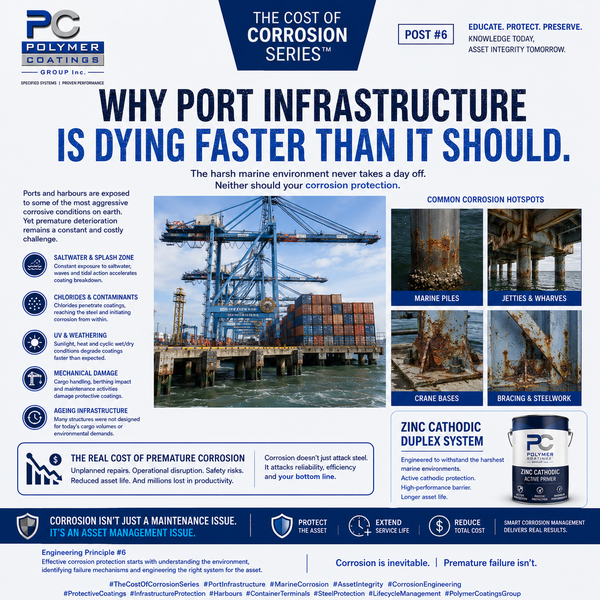
Why Port Infrastructure Is Deteriorating Faster Than It Should
Ports around the world move millions of tonnes of cargo on a daily basis.
➡ Container cranes lift around the clock ➡ Ships berth, load and depart ➡ Bulk terminals operate in some of the harshest environments on earth.
It's an industry built around reliability of infrastructure.
Below & above the waterline, one of the biggest threats to that reliability is often overlooked - "Corrosion"
Not the obvious rust that everyone can see. Slow, relentless deterioration taking place on marine piles, crane structures, jetties, walkways, pipelines & steelwork that are exposed to salt, moisture & oxygen every single day.
The marine environment is unforgiving. Salt-laden air accelerates corrosion long before steel is directly exposed to seawater.
The splash zone—where waves, oxygen and chlorides continuously interact—is one of the most aggressive corrosion environments found anywhere.
Add mechanical damage from cargo handling, vibration, impact, UV exposure & years of deferred maintenance & it's easy to understand, why so many port structures deteriorate long before their intended design life.
But here's the reality ↙
👉Most port infrastructure doesn't fail because it reaches the end of its design life. It fails because corrosion protection wasn't engineered with the operating environment in mind. The true cost isn't measured only in steel replacement but in:
Unplanned shutdowns, Emergency maintenance, Lost operational capacity, Increased safety risks, Escalating maintenance budgets &Reduced asset life.
Every day a critical asset is unavailable has a direct impact on productivity, vessel turnaround times & operating costs.
That's why corrosion protection should never be viewed as a maintenance expense, but as an investment in operational reliability.
Because of this very reason, we believe effective corrosion management starts through proper surface preparation, soluble salt removal, active cathodic protection and high-performance duplex coating systems so that steel structures can be protected against the harsh realities of the marine environment, helping owners maximize service life & reduce whole-of-life maintenance costs.
Preserving infrastructure isn't about applying more paint !!
It's about applying engineered solutions with proven performance.
Engineering Principle #6
The most effective corrosion management strategies are designed around the environment the asset operates in—not simply the coating applied to it. Understanding the exposure conditions is the first step toward extending service life.
Corrosion is inevitable. | Premature failure isn't.
#TheCostOfCorrosionSeries #PortInfrastructure #MarineCorrosion #CorrosionEngineering #AssetIntegrity #InfrastructureProtection #HarbourEngineering #ContainerTerminals #ProtectiveCoatings #LifecycleManagement #AssetPreservation #CathodicProtection #MarineEngineering #PolymerCoatingsGroup


