Since when should fast curing actually be the correct engineering solution?
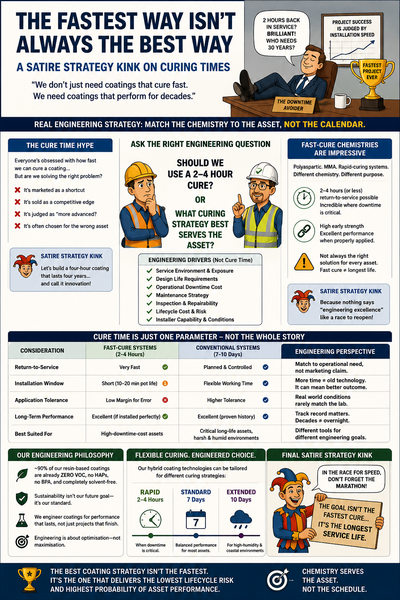
Fast-Cure Coatings: Are We Asking the Right Engineering Question?
The coatings industry is seeing an increasing emphasis on rapid "Return-to-service" technologies.
Advances in polyaspartic, methyl methacrylate (MMA), and other fast-reacting resin systems have made it possible for certain assets to return to operation within just a few hours. From a chemistry perspective, these developments are both impressive and represent significant advances in materials science.
But as I reflected on this trend, another question came to mind.
Not "Can we formulate a coating that cures in four hours?"
But rather...
"Have we reached a point where project schedules are beginning to dictate materials engineering, instead of materials engineering dictating project schedules?"
Perhaps that is the more important engineering discussion.
As engineers, our objective has never been to specify the fastest coating. Our responsibility is to specify the coating system that provides the highest probability of achieving an asset's intended service life under its actual operating conditions.
A fast-curing resin is not inherently a superior coating simply because it cures quickly, just as a conventional seven-day curing epoxy is not automatically the better solution because it cures more slowly.
Each chemistry has been developed to solve different engineering challenges.
For an airport runway, distribution warehouse, food processing facility or manufacturing plant where every hour of downtime carries a measurable financial impact, rapid "Return-to-service" may provide enormous operational value.
However, for infrastructure expected to remain in service for twenty or thirty years, where maintenance shutdowns are planned well in advance, the engineering priorities may be very different. Long-term durability, environmental exposure, chemical resistance, lifecycle cost, maintenance philosophy and proven service history may ultimately contribute more to the asset's success than recovering a few days & gaining bottom-line profit, during installation.
This is why coating selection should never begin with cure time.
It should begin with the asset.
Modern materials science has given us an expanding toolbox of resin chemistries, each with unique strengths and limitations. The engineering challenge is not determining which chemistry is universally "best," but selecting the chemistry that best aligns with the operational requirements and lifecycle objectives of the asset.
At Polymer Coatings Group, this philosophy has shaped our own research and development strategy.
Today, approximately 90% of our resin-based coating systems are already zero-VOC's( not just complying with legislated minimum's), solvent-free formulations containing no HAP's and no BPA's.
Environmental responsibility has therefore become an integral part of our engineering philosophy rather than simply a response to changing legislation.
More importantly, our recent formulation work has reinforced another principle.
Rather than designing every coating around a single curing profile, we have successfully adapted our hybrid coating technologies to accommodate different engineering requirements. Depending on the operational needs of the asset, these systems can be formulated for rapid 2 to 4-hour curing where downtime is critical, conventional 7-day curing where balanced performance is required, or extended 10-day curing for high-humidity coastal environments where controlled crosslink development may offer practical advantages during application.
To us, 👉 this flexibility represents engineering.
It recognises that not every asset has the same operational priorities, environmental exposure or maintenance strategy.
Perhaps that is the direction our industry should continue to pursue—not asking how quickly every coating can cure, but determining what curing strategy best supports the engineering objectives of the asset.
Because in the end, engineering is about optimisation, not maximisation.
The goal is not to produce the fastest curing coating.
Nor is it to produce the slowest.
The goal is to provide the coating system that delivers the lowest lifecycle risk and the highest probability of preserving the asset throughout its intended design life.
After all, the chemistry should always serve the asset.
It should never be the calendar that defines the engineering‼️
Polymer Coatings Group Inc.
Engineering the Science Behind Infrastructure Durability


