POST #11 THE COST OF CORROSION SERIES™ | FIELD OBSERVATION #11
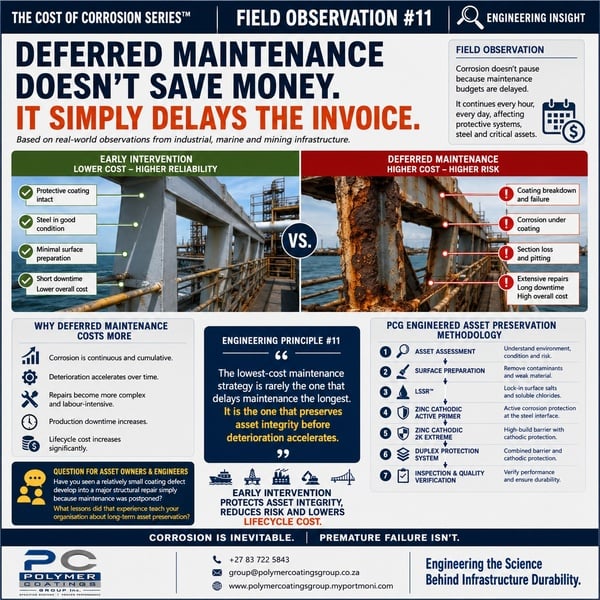
Deferred Maintenance Doesn't Save Money.
It Simply Delays the Invoice.
[Based on real-world observations from industrial, marine and mining infrastructure.]
One of the biggest misconceptions in infrastructure management is that postponing corrosion maintenance reduces costs.
In reality, it often does the opposite.
Corrosion doesn't pause because maintenance budgets are delayed.
It continues every hour, every day, gradually affecting protective coating systems, structural steel and critical assets.
A coating defect that could have been addressed during a planned maintenance shutdown may later require extensive surface preparation, steel repairs, production downtime and significantly higher rehabilitation costs.
That's why corrosion engineers rarely focus only on today's condition. They're thinking years ahead.
They understand that the objective isn't simply to repair deterioration.
It's to prevent deterioration from reaching the point where it affects structural reliability, operational availability and asset value.
This is where Asset Preservation becomes far more than a maintenance activity.
It becomes part of an organization's Asset Integrity, Reliability Engineering and Lifecycle Asset Management strategy.
Whether the asset is a marine structure, mining conveyor, processing plant, storage tank, pipeline or port facility, the engineering principle remains the same:
Early intervention almost always costs less than major rehabilitation.
For us at Polymer Coatings Group, this philosophy guides every recommendation we make.
Our approach begins with understanding the operating environment, assessing the condition of the asset and developing an engineered corrosion management strategy designed to maximize service life—not simply apply another coating.
Because the goal isn't to spend more on maintenance.
The goal is to spend it at the right time.
Engineering Principle #11
The lowest-cost maintenance strategy is rarely the one that delays maintenance the longest. It is the one that preserves asset integrity before deterioration accelerates.
Corrosion is inevitable. | Premature failure isn't.
Question for Asset Owners & Engineers
Have you seen a relatively small coating defect develop into a major structural repair simply because maintenance was postponed?
What lessons did that experience teach your organization about long-term asset preservation?
I'd be interested to hear your thoughts and experiences.


