Is chemistry alone responsible for coating durability?
A Leadership Article
Engineering the Science Behind Infrastructure Durability
Why Great Coatings Are About Much More Than Great Chemistry
Over the past few weeks, the coatings industry has seen some excellent discussions highlighting the importance of formulation chemistry, pigment technology and raw material selection in extending the service life of protective coatings.
There is no question that these factors are fundamental.
Advanced resin technology, functional pigments, specialized fillers, additives and corrosion-inhibiting chemistries have transformed the performance of modern protective coatings. Without continual innovation from raw material manufacturers and coating formulators, many of today's high-performance coating systems simply would not exist.
However, as engineers involved in infrastructure protection and asset preservation, we should perhaps ask a different question.
Is chemistry alone responsible for coating durability?
The answer is both simple and surprisingly complex.
The chemistry determines what a coating is capable of achieving.
Engineering determines whether it actually achieves it.
That distinction is often overlooked.
A Coating Is Only One Component of an Engineered Protection System
Across every sector—whether protecting bridges, water infrastructure, industrial facilities, marine assets, commercial buildings or manufacturing plants—the long-term success of any protective coating depends on far more than the formulation inside the container.
A coating system performs as part of an integrated engineering solution where every stage influences the next.
Failure at any one stage can compromise the performance of even the most advanced coating chemistry.
This is why experienced asset preservation specialists evaluate far more than simply selecting a premium coating.
They engineer the complete protection system.
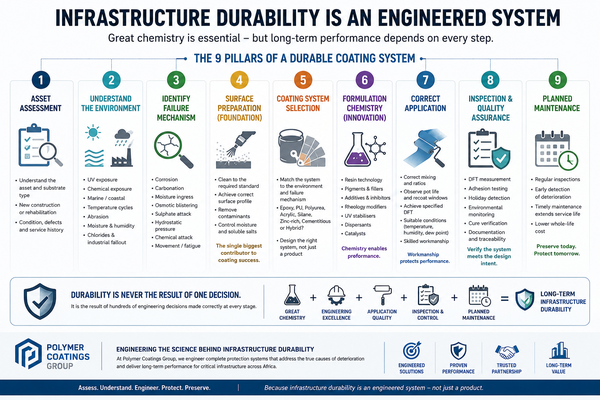
The Engineering Hierarchy Behind Long-Term Durability
At Polymer Coatings Group, we view infrastructure protection through a systems engineering approach.
Long-term durability depends upon successfully managing every stage of the protection process.
1. Asset Assessment
Every engineering solution begins with understanding the asset itself.
Different substrates behave differently.
Steel corrodes.
Concrete carbonates.
Masonry absorbs moisture.
Timber expands and contracts.
Each requires an entirely different protection philosophy.
2. Understanding the Exposure Environment
One coating cannot perform equally in every environment.
The coating selected for a coastal bridge may be entirely unsuitable for a wastewater treatment plant, a chemical processing facility or an office building.
Environmental exposure determines engineering requirements.
These include:
- Ultraviolet radiation
- Chloride contamination
- Industrial pollution
- Chemical exposure
- Abrasion
- Thermal cycling
- Moisture vapour transmission
- Hydrostatic pressure
- Biological attack
Each environment demands its own engineered solution.
3. Identifying the Failure Mechanism
Before selecting a coating, engineers should first understand why the substrate is deteriorating.
Is corrosion already active?
Is moisture migrating through concrete?
Is carbonation reducing reinforcement protection?
Is osmotic blistering occurring?
Has sulphate attack weakened the substrate?
Without correctly identifying the failure mechanism, even the best coating may simply conceal the problem rather than solve it.
4. Surface Preparation—The Foundation of Success
If there is one factor that consistently determines coating performance, it is surface preparation.
Contaminated steel.
Residual soluble salts.
Poor surface profile.
Dust contamination.
Excess moisture.
Weak concrete.
Surface laitance.
All of these can cause premature coating failure regardless of the quality of the coating itself.
Surface preparation is not simply preparation.
It is engineering.
5. Coating System Selection
Only once the engineering requirements are fully understood does product selection become meaningful.
Should the system be epoxy?
Polyurethane?
Polyurea?
Siloxane?
Elastomeric?
Zinc-rich?
Cementitious?
Hybrid technologies?
The correct answer depends entirely on the engineering requirements—not marketing claims.
6. Formulation Chemistry—Where Innovation Delivers Performance
This is where the tremendous work undertaken by raw material manufacturers and coating formulators becomes invaluable.
Modern performance depends on carefully engineered combinations of:
- Resin technology
- Functional pigments
- Corrosion inhibitors
- Speciality fillers
- Rheology modifiers
- UV stabilisers
- Wetting agents
- Dispersants
- Catalysts
These ingredients directly influence adhesion, weather resistance, flexibility, color retention, chemical resistance and long-term durability.
Formulation chemistry remains an essential pillar of coating performance.
But it is one pillar within a much larger engineering framework.
7. Correct Application
Even the finest coating formulation cannot compensate for poor workmanship.
Incorrect mixing ratios.
Expired pot life.
Insufficient dry film thickness.
Poor environmental conditions.
Incorrect curing.
All introduce risks that no formulation can overcome.
8. Inspection and Quality Assurance
Verification is fundamental to engineering.
Professional inspection confirms that design intent has been achieved through measurements, testing and documented quality control.
9. Planned Maintenance
No protective system should be expected to perform indefinitely without inspection.
Infrastructure preservation is not about waiting for failure.
It is about managing deterioration before failure occurs.
Planned maintenance significantly extends service life while reducing whole-life costs.
Durability Is Never the Result of One Decision
Long-term coating performance is not created by a single ingredient.
It is created by hundreds of engineering decisions made correctly throughout the lifecycle of an asset.
Exceptional chemistry contributes enormously.
So does engineering.
So does workmanship.
So does inspection.
So does maintenance.
Remove any one of these, and durability is compromised.
Engineering the Science Behind Infrastructure Durability
At Polymer Coatings Group, we believe our responsibility extends beyond supplying coatings.
Our role is to understand deterioration mechanisms, engineer complete protection systems and help asset owners maximize the service life of critical infrastructure.
Because infrastructure durability is never determined by chemistry alone.
It is achieved when science, engineering, application excellence and long-term asset management work together as one integrated system.
Engineering the Science Behind Infrastructure Durability.


