ENGINEERING WATER™ Volume 1 | Chapter 1 : Understanding Advanced Oxidation
An Engineering Publication by Polymer Coatings Group Inc.
" A continuation of our 'ENGINEERING WATER™' series"
Publisher & Editor
- Polymer Coatings Group Inc. R&D
Co-Author
- Gerald van Rensburg
Infographic Design
- PCG Media
Chapter 1 :
What Actually Happens When Oxidation Occurs?
Introduction:
When people hear the word oxidation, they often think only of rust forming on steel or chlorine being added to drinking water.
In reality, oxidation is one of nature's most fundamental chemical processes and forms the basis of many of the world's most advanced water treatment technologies.
Whether treating municipal drinking water, improving industrial process water, maintaining recreational water quality or addressing complex contaminants within mining operations, oxidation lies at the heart of modern water engineering.
Yet oxidation is frequently misunderstood.
Many treatment systems focus primarily on adding chemicals to water without fully understanding why oxidation occurs, what species are responsible for it, and how different oxidants interact with contaminants at a molecular level.
Understanding these principles allows engineers to move beyond reactive treatment and toward designing water systems that are more effective, sustainable and reliable.
Oxidation — A Natural Chemical Process
Oxidation is simply the process by which a substance loses electrons during a chemical reaction.
Within water treatment, this transfer of electrons alters the chemical structure of contaminants, converting them into compounds that are easier to remove, less harmful, or biologically inactive.
Depending on the oxidizing agent employed, oxidation may:
- Inactivate or destroy bacteria and viruses
- Break down organic contaminants
- Eliminate unpleasant tastes and odours
- Remove color compounds
- Oxidize sulphides responsible for foul odours
- Assist in removing iron and manganese
- Improve downstream clarification and filtration processes
For decades, oxidation has formed an essential component of municipal and industrial water treatment.
However, not all oxidation technologies perform equally.
The effectiveness of each oxidation technology depends upon the contaminants present, the characteristics of the water being treated and the desired treatment objective.
Conventional Oxidation vs Advanced Oxidation: 🦠
Traditional oxidizing agents such as chlorine(Cl₂) , chlorine dioxide (ClO₂), ozone (O₃) and hydrogen peroxide(H₂O₂) each play important roles within water treatment.
Each possesses specific strengths and operational limitations depending upon water quality, contaminant type and treatment objectives.
Advanced Oxidation Processes (AOPs) differ fundamentally because their distinguishing feature is not simply the addition of an oxidizing chemical, but the in-situ generation of highly reactive oxygen species capable of rapidly oxidizing contaminants.
Instead, they are engineered to generate highly reactive oxygen species capable of attacking contaminants with exceptional speed and efficiency.
These reactive species behave differently from conventional oxidants.
Rather than selectively reacting with only certain contaminants, they rapidly seek out a wide range of organic molecules, microorganisms and other undesirable compounds.
The Role of Reactive Oxygen Species (ROS)
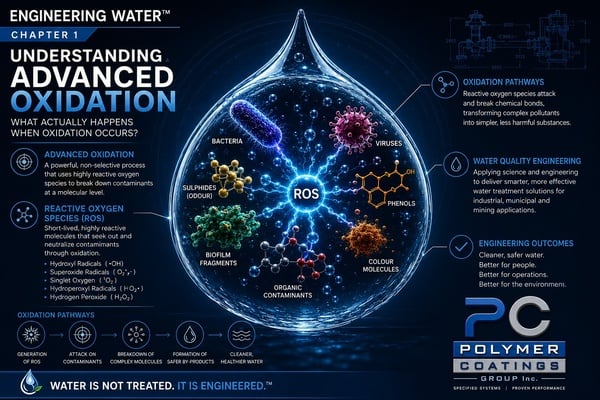
At the heart of Advanced Oxidation lies the formation of Reactive Oxygen Species (ROS).
These highly reactive chemical species exist only for extremely short periods, yet during their lifetime they possess remarkable oxidation potential.
Depending upon the Advanced Oxidation Process employed, Reactive Oxygen Species may include:
- Hydroxyl Radicals (•OH)
- Superoxide Radicals (O₂•⁻)
- Singlet Oxygen (¹O₂)
- Hydroperoxyl Radicals (HO₂•)
- Hydrogen Peroxide (H₂O₂) – an oxidising species and precursor for hydroxyl radical generation in many Advanced Oxidation Processes.
Because of their extremely high reactivity, these highly reactive species rapidly react with a wide range of contaminants including:
- Bacteria
- Viruses
- Biofilms
- Sulphides
- Phenolic compounds
- Colour-causing molecules
- Various organic contaminants
The result is often the degradation of complex contaminants into simpler, more manageable compounds that can subsequently be removed through subsequent biological treatment, filtration or natural degradation processes.
Why This Matters to Engineers?
Understanding oxidation is not simply an academic exercise.
Selecting an oxidation technology without understanding the underlying chemistry can lead to:
- Poor contaminant removal
- Unnecessary chemical consumption
- Increased operating costs
- Formation of undesirable treatment by-products
- Reduced treatment efficiency
More importantly, engineers should recognise that Advanced Oxidation does not produce identical outcomes under every set of operating conditions.
Its ability to oxidise, inactivate or degrade contaminants depends upon several engineering and operational factors, including:
- Water quality characteristics
- The type and concentration of contaminants present
- Contact time
- The efficiency of oxidant generation
- Overall system design and operating conditions
Understanding these variables enables engineers to select and optimise treatment systems based on sound engineering principles rather than relying on a one-size-fits-all treatment philosophy.
Water engineering therefore begins not with selecting a product, but with understanding the chemistry and engineering mechanisms that govern the treatment process.
Looking Beyond Chemistry
Although oxidation is fundamentally a chemical process, its influence extends into many other engineering disciplines.
Oxidation influences microbiological control through the control of bacteria and biofilms.
It influences environmental engineering by reducing contaminant loads before discharge.
It supports materials engineering by helping protect infrastructure from microbiologically influenced corrosion.
It contributes to public health through improved drinking water quality.
It assists mining operations in improving process water quality.
And it supports sustainable water reuse by enabling more effective contaminant removal.
In other words, oxidation is not merely a treatment step.
It is one of the engineering principles upon which modern water management is built.
Why This Matters?
Understanding Advanced Oxidation is not about learning another treatment technology.
It is about understanding one of the engineering mechanisms that governs modern water treatment.
Whether designing municipal drinking water systems, industrial process water treatment, recreational water facilities or mining water management programmes, engineers who understand oxidation are better equipped to select appropriate technologies, improve treatment efficiency and develop sustainable long-term water management strategies.
Because successful water engineering begins with understanding the science before selecting the solution.
Water is not simply treated | It is engineered.
Engineering Case Study :
Coming Next
Advanced Oxidation in Municipal Drinking Water
How understanding oxidation chemistry transformed contaminant removal and improved drinking water quality.
Technical Review
This publication forms part of the ENGINEERING WATER™ series published by Polymer Coatings Group Inc.
The purpose of this publication is to explain the scientific and engineering principles that underpin modern water treatment technologies. It has been prepared as an educational engineering resource for professionals involved in municipal, industrial, mining, hospitality, recreational and environmental water management.
The engineering concepts presented are intended to promote a deeper understanding of water treatment processes and should not be interpreted as product-specific technical specifications or design recommendations. Appropriate engineering assessment, water quality analysis and system design should always be undertaken when selecting or implementing any water treatment technology.


