ENGINEERING WATER™ - Volume 1
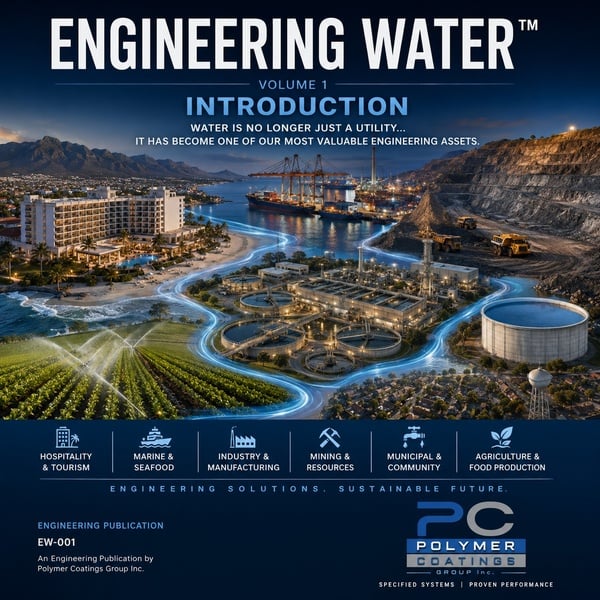
An Engineering Publication by Polymer Coatings Group Inc.
Publisher
- Polymer Coatings Group Inc.
Editor & Lead Author
- Gerald van Rensburg
- Chief Operating Officer | Corrosion Prevention & Asset Preservation Specialist |Protective Coating Engineering | Materials Performance Specialist.
Scientific Contributor
- Mohammed Nadjib Arbouche - Degree in Biotechnology and Plant Valorisation
Biotechnology Researcher - Plant Biotechnology | Nanotechnology | Green Materials | Sustainable Industrial Solutions | Innovation & Research - Biotechnology Researcher & Scientific Contributor to ENGINEERING WATER™
Introduction
Water Is No Longer Just a Utility...
It Has Become One of Our Most Valuable Engineering Assets.
We seldom think about water - Until something goes wrong!
- A hotel suddenly has discolored drinking water.
- A swimming pool has to be closed because water quality deteriorated overnight.
- A municipality issues another precautionary notice to boil drinking water.
- A mine begins experiencing process water quality issues that affect production.
- A seafood processor risks an export consignment because wash water no longer meets specification.
- A food producer faces increasing hygiene requirements.
- Or an entire community simply runs out of water.
Whether those challenges arise in Windhoek, Walvis Bay, Swakopmund, Rustenburg, Johannesburg, Port Elizabeth, Cape Town or any other growing community across Southern Africa, the engineering questions remain remarkably similar.
- How do we deliver water that is safe?
- How do we improve reliability?
- How do we protect infrastructure?
- How do we use water more sustainably?
And perhaps the most important question of all...
👉 How do we engineer better water?
For generations, water treatment was often regarded as a straightforward chemical process.
- Disinfect.
- Adjust the pH.
- Control algae.
- Clarify suspended solids.
The objective was simple:
- Produce acceptable water.
Today, that definition is no longer sufficient.
Modern water engineering has become one of the most multidisciplinary engineering fields in existence.
▫ Today's engineers are expected to protect public health while reducing environmental impact.
▫ Maintain industrial productivity while improving sustainability.
▫ Support mining, manufacturing, agriculture, tourism, municipalities and food production while working with increasingly scarce water resources.
▫ Design systems that are technically effective, economically practical and environmentally responsible.
Those are engineering challenges!!
Not simply chemical ones.
During the past few months, I have had the privilege of engaging with professionals from a remarkably diverse range of disciplines.
- Mining engineers.
- Consulting engineers.
- Corrosion specialists.
- Municipal practitioners.
- Hospitality operators.
- Water treatment professionals.
- Environmental scientists.
- Food processors.
- And, more recently, biotechnology researchers 👈
Although each profession views water through a different lens, one common theme has emerged from every conversation.
The future of water engineering will not be shaped by one discipline alone.
It will be shaped through collaboration.
One recent discussion captured that philosophy particularly well.
"The future of engineering will be driven by interdisciplinary collaboration, sustainability, and integrated systems thinking rather than isolated technologies."
— Mohammed Nadjib Arbouche
Biotechnology Researcher & Scientific Contributor to ENGINEERING WATER™
That single observation perfectly reflects the philosophy upon which this publication has been founded.
- Engineering has always progressed through collaboration.
- The greatest advances seldom occur when disciplines work independently.
They occur when engineers, scientists and researchers combine their knowledge to solve problems that no single field can solve alone.
Water engineering is rapidly becoming one of those disciplines.
- Whether supplying safe drinking water to guests at a hotel in Swakopmund...
- Supporting hospitality establishments throughout Namibia...
- Maintaining recreational water at coastal resorts in Cape Town...
- Providing potable water for mining personnel at uranium operations in Namibia or platinum mines around Rustenburg...
- Clarifying industrial process water in manufacturing facilities...
- Maintaining hygienic wash water for seafood processors in Walvis Bay...
- Protecting fresh produce destined for international export...
- Or assisting municipalities throughout Southern Africa to improve drinking water quality...
Every application presents unique operational challenges.
Every water source behaves differently.
Every industry has different performance objectives.
Consequently...
Every solution must be engineered.
There is no universal water treatment technology.
And there never will be...
Good engineering has never relied upon a single solution for every problem.
Instead, successful water engineering begins by understanding the source water, identifying the contaminants, defining the operational objectives and selecting the most appropriate combination of technologies.
- Sometimes clarification is the priority.
- Sometimes oxidation.
- Sometimes microbiological control.
- Sometimes metal remediation.
Increasingly...
It is all of these working together.
That is integrated water engineering!!
It is with this philosophy that Polymer Coatings Group introduces ENGINEERING WATER™.
Not as a product catalogue.
Not as a marketing publication.
But as a technical platform dedicated to exploring the engineering principles, scientific developments and practical technologies shaping the future of modern water management.
Throughout this series we will explore subjects including:
- Understanding Advanced Oxidation
- Engineering Water Clarification
- Coagulation & Flocculation Principles
- Heavy Metal Remediation
- Engineering Safe Drinking Water
- Recreational Water Engineering
- Mining & Industrial Water Systems
- Municipal Water Treatment
- Fresh Food Hygiene Water Engineering
- Water Reuse & Sustainability
- Biofilms & Microbiological Control
- Emerging Water Technologies
Some chapters will focus on engineering.
Others will explore chemistry.
Others will examine microbiology and biotechnology.
Collectively, they tell one story.
The story of how engineering disciplines are coming together to address one of society's most valuable resources.
Water.
Engineering Insight
At Polymer Coatings Group, we believe every water challenge deserves an engineered solution—not a one-size-fits-all treatment philosophy.
Our Integrated Water Engineering Platform has therefore been developed around five complementary technologies, each addressing a specific aspect of modern water quality management.
AQUA-CLEAR
Advanced Chlorine-Free Recreational Water Treatment Technology.
WATER-PURIFIER
Advanced Oxidation Water Treatment Technology for potable, municipal, industrial, mining and process water applications.
POLY-FLOC [ORG]
High-Performance Organic Coagulation & Flocculation Technology engineered for clarification and suspended solids removal.
POLY-MR
Advanced Metal Remediation Technology developed for industrial, mining and environmental water treatment applications.
WATER-PURIFIER – Fresh Food Hygiene Water Oxidation System
Advanced oxidation technology engineered for fresh produce washing, food processing, pack-houses and export-oriented food hygiene applications.
Together these technologies demonstrate how different engineering principles can be integrated to meet different operational requirements across hospitality, municipalities, mining, industry, agriculture, food processing and commercial facilities.
Throughout this publication, these technologies will be presented not as products, but as practical engineering examples illustrating broader treatment philosophies and integrated system design.
Coming Next
Chapter 1
Understanding Advanced Oxidation
What actually happens when oxidation occurs?
Not a chemistry lecture.
An engineering journey.
Together we'll explore how reactive oxygen species interact with bacteria, viruses, biofilms, sulphides, phenols, pharmaceuticals, color compounds and persistent organic contaminants—and why advanced oxidation has become one of the fastest-growing technologies in modern water engineering.
Because, in the end...
Water does not recognize municipal boundaries.
It does not recognize provincial borders.
And it certainly does not recognize national borders.
The engineering principles that protect a hotel in Swakopmund are often the very same principles that support a platinum mine in Rustenburg, a municipality in Gauteng, a seafood processor in Walvis Bay, or a food producer preparing products for international export.
Water connects every community.
Engineering is what keeps it working.
Welcome to ENGINEERING WATER™


