CRACK STAPLING SYSTEMS:
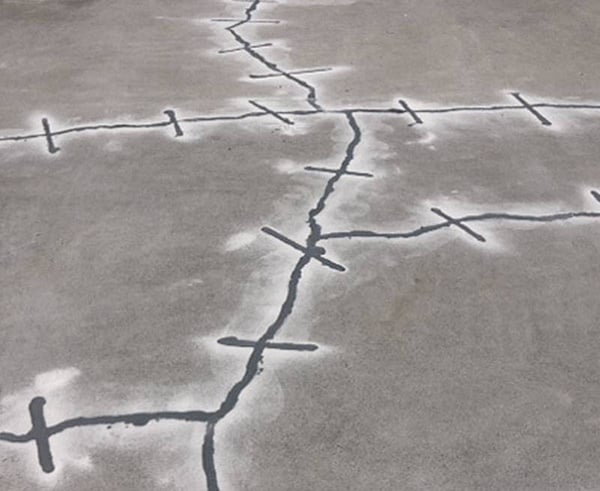
CRACK STAPLING SYSTEMS:
WHAT THEY DO — AND WHAT THEY DO NOT DO
One of the most commonly used crack repair methodologies in cementitious substrates today involves the installation of mechanical crack staples or stitching bars across visible cracks.
These systems are typically installed by:
• Chasing or cutting perpendicular slots across the crack line
• Inserting steel staples, stitching bars or reinforcement rods
• Anchoring them into epoxy or repair grout systems
• Closing the crack using fillers, mortars or coating systems
When correctly engineered and professionally installed, crack stapling systems can assist with:
✔ Load redistribution
✔ Localised crack stabilisation
✔ Crack edge restraint
✔ Limiting further crack propagation
✔ Improving slab continuity in certain applications
However, crack staples should never be misunderstood as a “complete repair solution”.
In reality, staples only assist in mechanically restraining visible crack movement at specific localised points.
They do NOT:
❌ Correct underlying structural failure
❌ Stop slab settlement
❌ Repair poor concrete mix integrity
❌ Eliminate subgrade movement
❌ Resolve water ingress beneath slabs
❌ Correct expansion design failure
❌ Stabilise weak suspended structures
❌ Restore deteriorated substrate density
If the root cause of substrate failure remains active, the slab will often continue cracking adjacent to the repaired area.
This is why many “repaired” floors begin cracking again only months later — often directly beside the original repair line.
OTHER PROFESSIONAL CRACK REPAIR METHODS AVAILABLE
Depending on the type of crack, substrate condition, movement behaviour and environmental exposure, professional repair methodologies may include:
✔ Epoxy Injection Systems
Used for:
• Structural crack bonding
• Monolithic crack restoration
• Load-bearing crack repair
Typically suited for:
• Static structural cracks
• Non-moving concrete structures
✔ Polyurethane Injection Systems
Used where:
• Moisture ingress exists
• Flexible movement is present
• Waterproof crack sealing is required
Commonly used in:
• Basements
• Water-retaining structures
• Negative-side waterproofing repairs
✔ Polymer-Modified Cementitious Repair Mortars
Used for:
• Surface rehabilitation
• Concrete reinstatement
• Spalled concrete repair
• Structural edge rebuilding
Professional systems should ideally include:
✔ Fibre reinforcement
✔ Polymer modification
✔ Latex emulsion enhancement
✔ Shrinkage reduction technology
✔ High adhesion characteristics
✔ Flexible Joint & Movement Systems
Required where:
• Ongoing thermal movement exists
• Expansion joints are active
• Structural movement cannot be eliminated
Rigid repairs installed over active movement zones almost always fail prematurely.
✔ Full Slab Rehabilitation Systems
In severe failure environments, proper repair may require:
• Substrate removal
• Structural reinforcement correction
• Recasting sections of slab
• Soil stabilization
• Drainage correction
• Waterproofing rehabilitation
• Movement redesign
In many infrastructure failures, the crack itself is merely the final visible symptom of a much larger engineering problem.
THE DANGER OF USING NON-POLYMER MODIFIED REPAIR MATERIALS
A major issue within the current repair market is the widespread use of:
❌ Standard tiling cement
❌ Basic grout systems
❌ Non-modified sand/cement patch repairs
❌ Low-flexibility repair mortars
These systems generally lack:
• Flexural strength
• Adhesion performance
• Crack-bridging capability
• Shrinkage control
• Long-term moisture resistance
• Thermal movement tolerance
As a result, many repairs become brittle over time and begin failing under:
• Thermal cycling
• Vibration
• Moisture ingress
• Structural movement
• Dynamic loading conditions
WHY POLYMER-MODIFIED FIBRE-ENRICHED REPAIR SYSTEMS MATTER
Professional repair compounds developed with:
✔ Polymer modification
✔ Fibre reinforcement
✔ Latex emulsion technology
✔ High-bond chemistry
✔ Controlled flexibility
✔ Reduced shrinkage characteristics
provide significantly improved long-term performance because they are engineered to work WITH the behaviour of the substrate — not against it.
These systems are specifically designed to:
• Improve adhesion to existing concrete
• Reduce brittle failure
• Improve flexural performance
• Increase crack resistance
• Improve impact tolerance
• Enhance lifecycle durability
EXPECTED LIFE EXPECTANCY OF REPAIRS
The lifespan of any cementitious crack repair system depends entirely on:
• Correct diagnosis of the failure mechanism
• Structural integrity of the slab
• Moisture conditions
• Movement behaviour
• Environmental exposure
• Repair methodology used
• Material engineering quality
However, as a general industry observation:
Cosmetic or shortcut repairs using:
❌ Standard tile adhesive
❌ Basic grout
❌ Non-modified mortars
❌ Surface-only patching
may begin failing again within:
• 6 months to 3 years
particularly where active movement or moisture remains present.
Whereas professionally engineered polymer-modified repair systems combined with proper structural assessment and movement control can substantially extend:
✔ Service life
✔ Structural integrity
✔ Waterproof performance
✔ Long-term substrate stability
often delivering dramatically lower lifecycle maintenance costs over extended periods.
At Polymer Coatings Group, we strongly believe that concrete repair should never be approached as “patch-and-hide maintenance”.
It should be approached as engineered substrate rehabilitation focused on long-term infrastructure preservation.
Because protecting infrastructure begins beneath the surface.


