Copper Ions, Bioavailability and Environmental Risk: A Modern Engineering Review
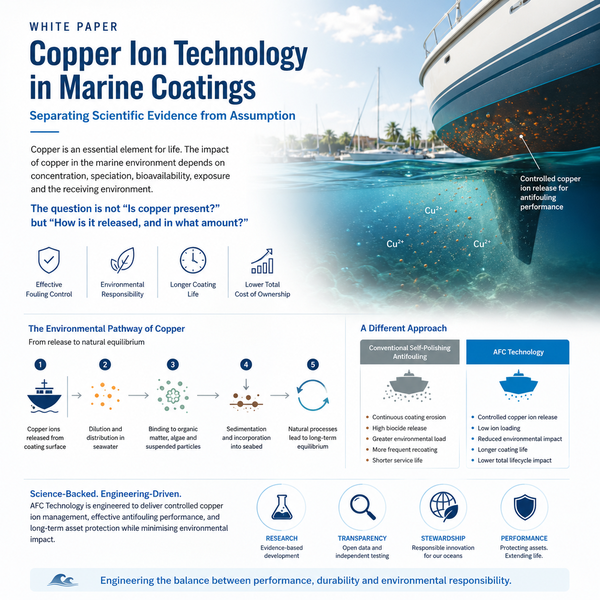
Rethinking Copper in Marine Antifouling: An Engineering Perspective
Separating Scientific Evidence from Assumption
"Engineering decisions should be driven by measurable science—not by assumptions, perceptions or incomplete interpretations of environmental data."
I recently saw a video, in which a few statements was made regarding the age-old use of Copper in swimming / bath water in the olden days, as well as the removal of copper piping in modern plumbing, as well as the use of copper piping in the drinking bowls of livestock, plus the hygienic/healing properties of free copper ions in water.
Now firstly, I did not reference this video out of personal and/or company endorsement, but simply for discussion and informative purposes. The opinions expressed in the video is not our opinion nor do we endorse it.
So a question arose, following the viewing of this video, specifically regarding the formulation and utilization of conventional polishing anti-fouling coatings and the newer and varied Anti-Fouling Coating Technology, still utilizing :
- the sacrificing the coating to release biocides or
- preserve the coating while delivering controlled antifouling performance.
[This discussion does not apply to Self-Polishing Co-Polymer Technology Coatings]
So has the use of Copper Ion release technology in AFC Coatings, really scientifically been proven to toxify the marine environment for organisms?
This is a fascinating question because it gets to the heart of one of the biggest misconceptions in environmental chemistry:
⚡the difference between the element copper and the bioavailable copper ion, the concentration, and the rate of release.
The short answer is:
No, copper ion release technology is not inherently environmentally toxic.
What matters is : 👉 how much copper is released, in what chemical form, where it is released, and whether the receiving environment can dilute or bind it.
Over the past two decades, the marine coatings industry has experienced a significant shift in environmental policy. Increasing regulatory pressure has encouraged manufacturers and vessel owners to move away from traditional copper-based antifouling technologies, largely because of concerns surrounding copper accumulation in marina sediments and its potential impact on sensitive marine ecosystems.
This shift has undoubtedly accelerated innovation. However, it has also created an important scientific question that deserves careful examination:
Is copper itself the environmental problem, or is the challenge the uncontrolled release of bioavailable copper ions into confined aquatic environments over extended periods?
These are not equivalent questions.
Copper is neither a synthetic contaminant nor a foreign substance introduced into marine ecosystems. It is a naturally occurring trace element that has been essential to biological life for hundreds of millions of years. Every living organism—from bacteria and algae to fish and humans—depends upon copper for critical enzymatic and metabolic processes.
At the same time, modern eco-toxicology has clearly demonstrated that excessive concentrations of dissolved copper ions can adversely affect sensitive aquatic organisms, particularly in poorly flushed harbours and marinas where continuous inputs may lead to long-term sediment enrichment.
Both statements are scientifically correct.
Unfortunately, discussions surrounding copper-based antifouling technologies are often reduced to a simplified narrative in which copper is classified as either "safe" or "toxic." Such binary conclusions overlook one of the most fundamental principles of chemistry:
The environmental impact of any substance is determined not merely by its presence, but by its concentration, chemical speciation, bioavailability, exposure duration and receiving environment.
This distinction is central to understanding both the limitations of conventional copper-rich antifouling coatings and the opportunities presented by modern controlled ion-release technologies.
The purpose of this paper is not to advocate for unrestricted copper use, nor to challenge the substantial body of environmental research conducted over recent decades. Instead, this paper seeks to examine the available scientific evidence objectively, review what is currently understood about copper behaviour in marine environments, and explore whether carefully engineered, ultra-low controlled copper ion release systems can achieve effective antifouling performance while substantially reducing environmental impact.
The discussion that follows is intended for marine engineers, coating specialists, naval architects, environmental scientists, drydock managers and asset owners who seek evidence-based engineering solutions rather than simplified conclusions.
Let's unpack this scientifically :
The Chemistry of Copper :
Copper is an Essential Element , Copper (Cu) is not a synthetic poison. It is an essential trace nutrient required by:
- humans
- fish
- algae
- shellfish
- bacteria
- plants
Without copper:
- enzymes stop functioning
- photosynthesis fails
- oxygen transport becomes impaired
- immune systems weaken
Every living organism requires copper, but the problem begins when concentrations exceed biological tolerance. Exactly the same is true for: Iron, Zinc, Selenium & Manganese.
They are all essential, but toxic at excessive concentrations.
The Oligodynamic Effect
Why did copper pipes become popular?
For centuries people noticed something they couldn't explain scientifically. Water stored in copper vessels stayed "fresh." Later microbiology explained why. Copper ions damage:
- bacterial cell walls
- fungal spores
- viruses
- algae
This is called the oligodynamic effect.
It occurs naturally with metals like:
- Copper
- Silver
- Brass
Hospitals today still install copper door handles because bacteria die rapidly on copper surfaces.
Why were livestock troughs often copper( or contain copper piping submersed in the water)?
Farmers learned through observation.
Copper troughs:
- stayed cleaner
- developed less slime
- reduced algae growth
- reduced bacterial contamination
Not because copper sterilized the water...
Because tiny quantities of copper ions continuously entered the water.
Very low concentration.
Enough to suppress microbes.
Far below toxic concentrations for livestock.
What the Research Actually Shows :
Why regulators became concerned?
In the 1980s and 1990s, many antifouling paints relied on:
Very high copper loading, combined with booster biocides. Examples included compounds designed to kill algae, barnacles, and other fouling organisms.
The environmental concern wasn't solely copper—it was the combination of high copper release rates and additional toxic biocides, particularly in enclosed harbors where accumulation could occur over time.
So has any actual scientific results ever been published with accumulation results say over 10 to 15 year period especially in environments which are enclosed and have slow natural flushing?
Yes.
Several examples include: ( please note this information is based on references given following each example and we do not state that we agree/disagree with the testing methods nor the validity of the results declared - it is for reference purposes only )
- Auckland, New Zealand developed models comparing predicted and measured copper accumulation over roughly 10–11 years between dredging events, finding reasonable agreement between predictions and measured sediment concentrations. ( https://knowledgeauckland.org.nz/media/1404/tr2012-033-antifouling-biocides-in-marinas.pdf?utm_source=chatgpt.com )
- England used dated sediment records from boating lakes to reconstruct copper enrichment over many years, showing sustained enrichment associated with recreational boating. (https://link.springer.com/article/10.1007/s10933-015-9865-z?utm_source=chatgpt.com )
- Brazil (2024) reconstructed contamination through sediment cores spanning marina development and operation, documenting a clear historical increase after the marina opened. ( https://pubmed.ncbi.nlm.nih.gov/38850759/?utm_source=chatgpt.com )
- Numerous studies in Sweden, Finland, Washington State, and elsewhere have monitored marinas over multiple seasons and years, consistently showing elevated copper during boating seasons and accumulation in enclosed marina environments. ( https://pubmed.ncbi.nlm.nih.gov/32394257/?utm_source=chatgpt.com )
In fact, this is one area where the environmental regulators are standing on fairly solid scientific ground.
However—and this is the important part—the results are often misrepresented in public discussions.
The studies generally do not conclude that "copper is destroying the oceans." They conclude something much more specific:
Copper can accumulate in poorly flushed marinas and harbour sediments over many years, primarily as a result of continuous inputs from antifouling coatings.
That is a very different statement.
The evidence goes back decades
Researchers have been studying this since the 1990s.
The strongest evidence comes from sediment core studies.
These work much like tree rings.
Scientists collect a vertical core of seabed sediment and date each layer using radioactive isotopes (such as lead-210 or cesium-137). They can then reconstruct what the copper concentration was year by year over several decades.
One of the most convincing recent studies, published in 2024, examined sediment deposited before and after a marina was built. The researchers found that copper concentrations increased dramatically after marina operations began—up to about 15 times the local background concentration in some sediment layers—and the timing matched the introduction and continued use of copper-based antifouling paints. (https://pubmed.ncbi.nlm.nih.gov/38850759/?utm_source=chatgpt.com )
But here's where it gets interesting...
The accumulation is mostly in the sediment, not in the open water.
Think of the process like this:
Boat hull
↓
Copper ions released
↓
Copper binds to:
- algae
- suspended organic matter
- clay particles
- fine silt
↓
Particles settle
↓
Copper becomes buried in harbour sediments.
This is exactly what the 2022 Puget Sound study found. The researchers observed elevated copper inside marinas, but they also found that much of the copper became associated with suspended sediment and algae before being deposited on the marina bottom. They did not find corresponding copper accumulation in transplanted mussels during their monitoring period. ( https://www.sciencedirect.com/science/article/pii/S0025326X22002296?utm_source=chatgpt.com )
That is an important distinction.
Does it keep increasing forever?
Interestingly...
No.
This surprised me when I first read the literature years ago.
Copper doesn't simply remain dissolved indefinitely.
Instead it reaches something closer to a dynamic equilibrium:
- new copper enters
- some binds strongly to sediments
- some is buried
- some is resuspended
- some is exported from the harbour
- some becomes chemically unavailable
The system reaches a balance that depends on:
- flushing rate
- dredging
- boat density
- water movement
- sediment chemistry
- organic carbon
So a heavily enclosed marina behaves very differently from an exposed commercial harbour. ( https://www.sciencedirect.com/science/article/pii/S0025326X22002296?utm_source=chatgpt.com )
Modern controlled release systems :
Today's technology is much smarter.
Engineered coatings attempt to:
- reduce copper loading
- control ion release
- maintain efficacy
- minimize environmental release
Some coatings combine:
- surface engineering
- hydrophobicity
- low-energy surfaces
- minimal copper release
Instead of relying on massive copper dissolution.
Could AFC argue environmental benefits?
Potentially yes—provided the science supports it.
If AFC demonstrates:
- significantly lower copper release than conventional antifouling paints,
- controlled ionic release rather than high dissolution rates,
- elimination of additional toxic booster biocides,
- longer coating life (meaning fewer recoating cycles),
- lower fuel consumption due to cleaner hulls (reducing greenhouse gas emissions),
then the overall environmental impact could be lower than traditional systems.
This is a classic life-cycle assessment question rather than simply asking whether copper is present.
My engineering opinion -
Based on corrosion science, marine chemistry, and environmental engineering, I don't think the statement "copper is toxic" is scientifically complete.
A more accurate statement would be:
Copper is an essential trace element. Like many naturally occurring elements, it becomes harmful only when bioavailable concentrations exceed the tolerance limits of specific organisms. The environmental impact therefore depends on release rate, concentration, exposure, and the sensitivity of the receiving ecosystem—not merely on the presence of copper itself.
That distinction is crucial. It's similar to saying oxygen is essential for life, yet oxygen radicals can damage cells, or that iron is vital for health but harmful in excess. The chemistry, concentration, and context determine the outcome.
For AFC technology, this opens an opportunity to position the technology around controlled ion management rather than "copper as a biocide."
If data can be generated, showing ultra-low, controlled copper ion release that achieves antifouling performance while keeping environmental concentrations well below ecotoxicological thresholds, that becomes a much stronger scientific and regulatory argument than simply stating the coating contains copper.
I also think this is an area where Polymer Coatings Group differentiates ourselves.
Instead of joining the polarized debate of "copper good" versus "copper bad," we rather educate customers on the science of dose, bioavailability, controlled release, and life-cycle environmental impact.
That approach aligns with our identity of :
Engineering the Science Behind Infrastructure Durability.
Life-Cycle Assessment : ↩
👉 But here is the question I would ask as an engineer...‼
This is where I think there is a significant gap in the discussion.
Most studies ask:
"Is copper accumulating?"
Very few ask:
"Compared with what?"
For example:
Suppose AFC released 90% less copper than a conventional self-polishing antifouling.
Would it still accumulate?
Probably yes.
Would it be environmentally significant?
That becomes a quantitative question rather than a yes/no question.
Likewise:
Suppose AFC lasts 15 years while a conventional coating lasts 5 years.
Over 15 years you would apply:
- One AFC system
- Three conventional systems
The total copper released over the asset's life could be substantially different.
That is a life-cycle assessment question, and it's the type of comparison that regulators and sophisticated customers increasingly value.
This is why I'm interested in AFC 👈
From everything discussed , AFC doesn't appear to be trying to flood the environment with copper ions. Its concept is controlled ion management.
If AFC can demonstrate scientifically that:
- the copper release rate is significantly lower than conventional antifouling paints,
- the ions are released in a tightly controlled manner,
- no additional booster biocides are required,
- and long service life reduces the frequency of recoating,
then the environmental conversation shifts from "Does it contain copper?" to "What is the total environmental footprint over the coating's entire service life?"
I actually think that's where the future lies.
Environmental regulation is increasingly moving away from judging products solely by the presence of a particular ingredient and toward evaluating whole-life environmental impact.
If AFC Technology can generate robust, peer-reviewed release-rate data and life-cycle assessments, it would have a compelling scientific basis for distinguishing itself from conventional copper-rich antifouling technologies.


